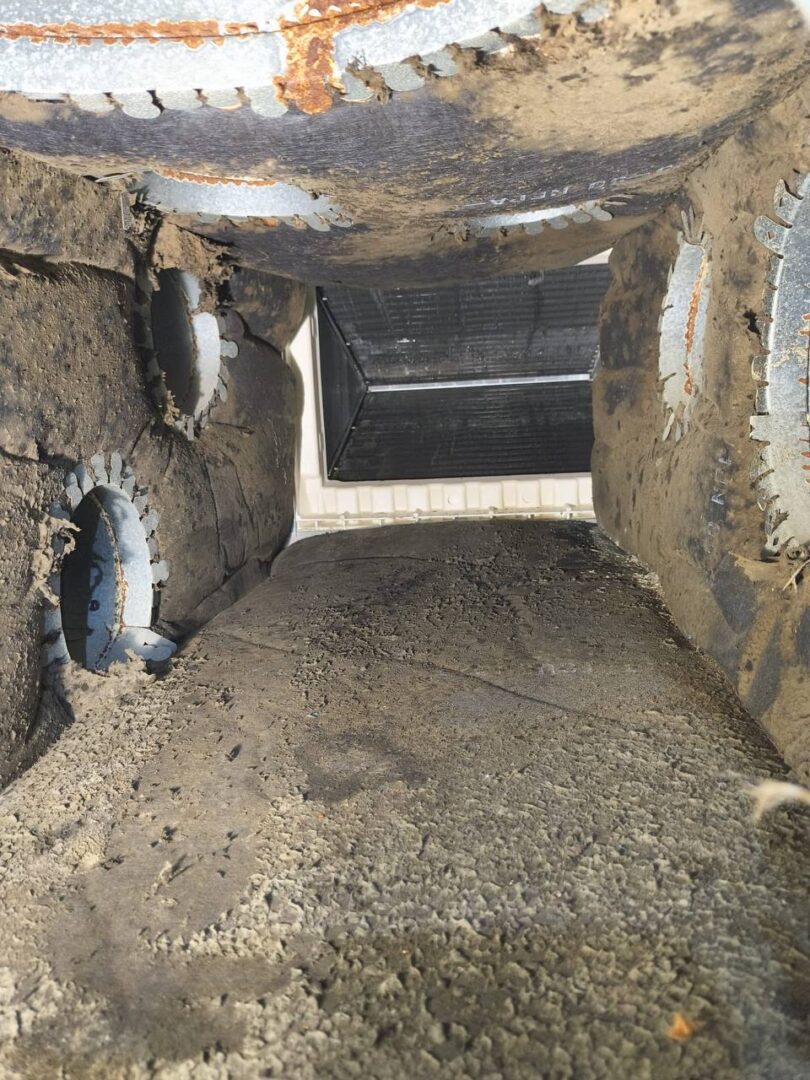
Austin has an indoor air problem that is easy to misread. The city ranks among the fastest-growing metros in the country, sits at the eastern edge of the Edwards Plateau, and is bisected by a freight corridor that carries some of the heaviest truck traffic in Texas. Those three facts — limestone geology, interstate diesel, and sustained construction — produce a particulate and moisture profile that is genuinely different from Houston, Dallas, or the surrounding Hill Country towns.
Most of that material does not stay outdoors. It enters through return-air intakes, settles on duct surfaces, and then recirculates every time the system runs. Understanding which pollutants Austin homes actually accumulate is the difference between guessing at indoor air quality and addressing it at the source.
This guide breaks down the specific factors that shape indoor air in Austin proper — not the suburbs, and not a generic Texas summary — and explains what a professional assessment should look for. If you want a technician to evaluate your own system, schedule a free inspection before reading further.
What Makes Austin’s Indoor Air Different
Five local conditions drive the indoor air profile in Austin homes. Each one leaves a different signature in the duct system, and each requires a different part of the cleaning process to address it properly.
- The Central Texas cedar pollen basin. Austin sits inside the native range of Juniperus ashei — Ashe juniper, which nearly everyone locally calls “mountain cedar.” It releases pollen from roughly December through February, and the grains are small enough to travel long distances on dry north winds. Cedar season overlaps with the months when most Austin homes keep windows closed and the heat running, which means the HVAC system becomes the primary path for pollen that would otherwise stay outside. Cedar pollen is one of the most well-documented seasonal allergens in Central Texas.
- I-35 freight traffic and diesel particulate. Interstate 35 runs through the center of the city and functions as a national freight artery. Diesel exhaust produces fine particulate matter that stays airborne far longer than road dust, and it penetrates building envelopes through gaps that are invisible from inside. Homes within a few blocks of the interstate, and properties downwind of the elevated sections through downtown and south Austin, tend to accumulate a finer, darker film on registers than neighborhoods farther west.
- Limestone and caliche construction dust. Austin’s bedrock is Edwards Group limestone, and much of the west and northwest metro sits on caliche — a calcium-carbonate hardpan that turns to fine, alkaline powder when it is cut, graded, or excavated. Every new subdivision, foundation pour, and road widening produces that powder. Limestone dust is abrasive, mildly alkaline, and settles quickly, which is why it concentrates in return plenums and on the blower wheel rather than staying suspended.
- Humid summers plus cold duct surfaces. Central Texas summers routinely hold relative humidity high enough that a duct running through an unconditioned attic sweats. Condensation on the exterior of the duct is a moisture problem; condensation on the interior is worse, because dust that has settled there becomes a food source for microbial growth. Austin’s long cooling season means this cycle repeats for months at a time.
- Rapid infill and a mixed housing stock. Austin has both 1950s bungalows in central neighborhoods and brand-new builds on the fringe, often on the same street grid. Older homes frequently have undersized returns and unsealed sheet-metal joints. Newer homes frequently have long flex-duct runs in hot attics with loose connections at the boots. The failure modes are opposite, but both deliver attic air and debris into the living space.
Where Austin’s Outdoor Air Actually Ends Up
A residential duct system moves several hundred cubic feet of air per minute through a network that is mostly hidden — in attics, between joists, and above ceilings. That network is not a sealed pipe. Every joint, boot, and register connection is a potential leak, and in a typical Austin attic the pressure differential across those leaks pulls unconditioned attic air into the supply side.
What settles out of that airflow depends on particle size, and each size class behaves differently:
- Large and heavy (limestone dust, road grit, insulation fibers). Drops out fastest, collecting on horizontal duct runs, in return plenums, and on top of the blower housing.
- Fine (diesel PM2.5, cedar pollen fragments, smoke particles). Stays suspended longer, coats duct walls in an even film, and is small enough to pass through standard filters and re-enter the breathing zone.
- Biological (mold spores, dust-mite debris). Accumulates wherever moisture is present — the cooling coil, the drain pan, and any duct section with condensation issues.
The practical consequence is that a duct system can look acceptable at the registers while holding years of settled material further downstream. Registers are the easiest part of the system to wipe clean and the least informative place to judge condition from.
Six Signs an Austin Home Needs a Duct Assessment
- Visible dust on supply registers within days of cleaning them. This usually indicates the contamination is upstream, not on the register face.
- A musty or “closed-up” smell when the air handler starts. Odor on startup points to the coil, drain pan, or the first few feet of duct downstream of the coil.
- Uneven cooling between rooms, especially upstairs. Leaky or undersized runs in a hot attic deliver less conditioned air and more attic air to the rooms at the end of the run.
- Recent renovation, foundation work, or nearby construction. Limestone and drywall dust generated during the project migrate into returns and stay there long after the visible mess is gone.
- Filter faces that load unevenly or collapse. A filter that bows toward the blower is a sign of excessive static pressure, often from restricted or undersized return ducting.
- More than three years since the last inspection. Debris accumulates on a schedule, not on a reminder. An inspection establishes the actual condition instead of assuming it.
What NADCA-Certified Cleaning Does Differently
The National Air Duct Cleaners Association publishes the ACR standard — Assessment, Cleaning, and Restoration — which defines what a legitimate cleaning project includes. In practice, that means the work is source removal under controlled pressure, not a surface wipe-down.
- Assessment first. Before any equipment runs, the system is inspected to determine whether cleaning is warranted and what the contamination actually is. Not every system needs cleaning; a truthful assessment will say so.
- Negative pressure containment. A high-volume vacuum with HEPA filtration holds the duct system under negative pressure so dislodged debris travels to the collection unit instead of into the rooms.
- Mechanical agitation. Rotary brushes, air whips, and compressed-air tools physically break loose adhered material from duct walls. Vacuum alone does not remove material that has bonded to the surface.
- Component-level cleaning. The blower, cooling coil, drain pan, and accessible plenum surfaces are part of the system. Cleaning the ducts while leaving a fouled coil in place returns the debris to the airstream immediately.
- Verification and documentation. Before-and-after photographs of the same duct sections, plus a written summary of what was found. Condition documentation is the only way a homeowner can evaluate the work objectively.
AH-CHOO is NADCA-certified and has been performing this work for 38 years. For a fuller explanation of what the certification requires and how to verify it for any contractor, see the air duct inspection guide.
What Austin Homeowners Can Do Between Service Visits
Duct cleaning is a point-in-time intervention. Keeping the result depends on a handful of habits that matter more in Austin than in most markets:
- Match the filter to the system, not to the highest number on the shelf. A MERV 8 to MERV 11 pleated filter captures a useful share of respirable particles without over-pressurizing a residential blower. Very high-MERV filters in an undersized return can reduce airflow enough to cause coil icing and higher static pressure.
- Change filters on a calendar, not on appearance. During cedar season and after any construction nearby, a filter can load in weeks while still looking gray rather than black.
- Keep indoor humidity in the 30–50% range. This is the range where condensation on cool duct surfaces is least likely and where microbial growth is discouraged. In an Austin summer that usually requires deliberate dehumidification, not just air conditioning.
- Seal the obvious leaks. Mastic or foil tape at plenum connections, boot-to-floor joints, and accessible flex-duct collars. Duct tape degrades in attic heat; use materials rated for the temperature.
- Control what comes in. A walk-off mat at each exterior door, shoes off, and keeping windows closed during cedar peaks and regional smoke events all reduce the load the filter has to handle.
- Watch for moisture, not just dust. Any rust streak, water stain, or musty smell near the air handler is a moisture finding that should be addressed before it becomes a microbial one. For persistent moisture or visible growth, see mold remediation in Austin.
Frequently Asked Questions
How often should Austin homeowners have their air ducts inspected?
NADCA’s consumer guidance puts inspection and cleaning on a three-to-five-year baseline for a typical home. Austin homes near active construction, within a few blocks of I-35, or with pets and recent renovation may benefit from an inspection sooner, because debris loading in those conditions is faster than the general baseline.
Does air duct cleaning help with cedar pollen in Austin?
It removes pollen that has already settled inside the duct system, so the HVAC system stops recirculating it. Cleaning is not a substitute for filtration and source control — a correctly sized filter changed during cedar season is what limits the volume of new pollen entering the system. The two work together.
Why does my Austin home get dusty so quickly after cleaning?
Fast re-accumulation usually points to one of three causes: duct leakage pulling attic or wall-cavity air into the supply side, an undersized return that raises velocity and keeps fine dust suspended, or ongoing construction nearby. Cleaning the ducts without addressing the leak path returns the same result within weeks.
Is limestone dust from construction a real indoor air concern?
It is a real particulate load. Limestone and caliche dust generated by grading, foundation work, and road construction is fine, alkaline, and abrasive, and it settles throughout a home’s duct system during and after the project. It is a common finding in Austin homes that have had nearby construction within the previous two years.
Does AH-CHOO perform indoor air quality monitoring or laboratory sampling?
No. AH-CHOO performs NADCA-certified air duct cleaning, HVAC component cleaning, and source removal. We do not perform indoor air quality monitoring, laboratory sampling, or health assessment. Our work is directed at removing accumulated debris from the system so it can operate as designed.
Which Austin areas does AH-CHOO serve?
AH-CHOO serves Austin and the surrounding Central Texas communities, including Round Rock, Cedar Park, Pflugerville, Leander, Kyle, Buda, Georgetown, and San Marcos. Visit Austin air duct cleaning for service details, or contact us to confirm coverage for a specific address.
Indoor Air Quality Across the Austin Metro
Austin’s air quality problems are regional, but they land differently depending on where a home sits. The surrounding community guides cover the local variations in detail:
- Indoor air quality in Buda TX — I-35 dust and Onion Creek humidity
- Indoor air quality in Leander TX — construction dust and rapid growth
- Indoor air quality in Kyle TX — diesel particulate and Plum Creek humidity
- Indoor air quality in Pflugerville TX — new-build ductwork and pollen load
For the underlying mechanics of how a duct system accumulates and distributes debris, the complete air duct cleaning guide covers the full process from assessment through restoration.
Get an Assessment Before You Schedule Anything
Not every Austin home needs duct cleaning, and the only reliable way to know is to look. AH-CHOO’s inspection covers the air handler, coil, plenum, and accessible duct runs, with photographic documentation of what is actually there. If the system is clean, we will tell you that.
Request a free inspection — NADCA-certified, 38 years in Texas, serving Austin and the surrounding communities.
This information is educational. AH-CHOO’s air duct cleaning services are designed to improve HVAC system cleanliness and indoor air quality through source removal of accumulated debris. They are not intended to diagnose, prevent, or resolve any health condition, and outcomes are not assured. Results vary with home conditions, occupancy, and ongoing moisture sources. Consult a qualified professional for health concerns related to indoor air.