Houston summers are relentless. From June through September, temperatures regularly climb above 95°F, the humidity pushes the heat index past 105°F, and your air conditioning system runs almost continuously just to keep your home livable. In this environment, your HVAC system isn’t just working hard — it’s working harder than it was designed for, every single day.
While most Houston homeowners understand that summer means higher energy bills, fewer people realize how the extreme heat directly affects their HVAC system’s performance — and how the condition of their air ducts plays a critical role in whether their system can keep up when it matters most.
How Houston’s Heat Profile Differs from Other Markets
To understand why Houston heat is particularly hard on HVAC systems, it helps to compare it to other parts of the country:
- Cooling degree days (CDD): Houston averages over 3,000 cooling degree days per year — roughly three times the national average. Your AC runs more hours annually than systems in most major U.S. cities.
- Extended cooling season: Houston’s cooling season runs from April through October — seven months of near-continuous AC operation. Many systems never get a meaningful break.
- Heat + humidity compound effect: The combination of high temperature and high humidity forces your AC to work harder to remove moisture (latent cooling), which accounts for 40–60% of the system’s workload during summer.
- Urban heat island: Houston’s urban core and dense suburban developments absorb and retain heat, creating microclimates where temperatures are 3–7°F higher than surrounding rural areas. This pushes AC demand even higher.
When you factor in that many Houston homes were built in the 1970s–1990s with undersized or aging ductwork, the strain on the HVAC system becomes even more pronounced.
Six Ways Extreme Heat Stresses Your HVAC System
1. Continuous Runtime Reduces Component Life
Your HVAC system is designed to cycle on and off throughout the day. During Houston’s peak summer weeks, many systems run 16–20 hours per day without ever reaching the thermostat setpoint. This continuous runtime accelerates wear on the compressor, blower motor, capacitors, and contactors — the components most likely to fail during a heat wave.
2. Dirty Ducts Raise Static Pressure
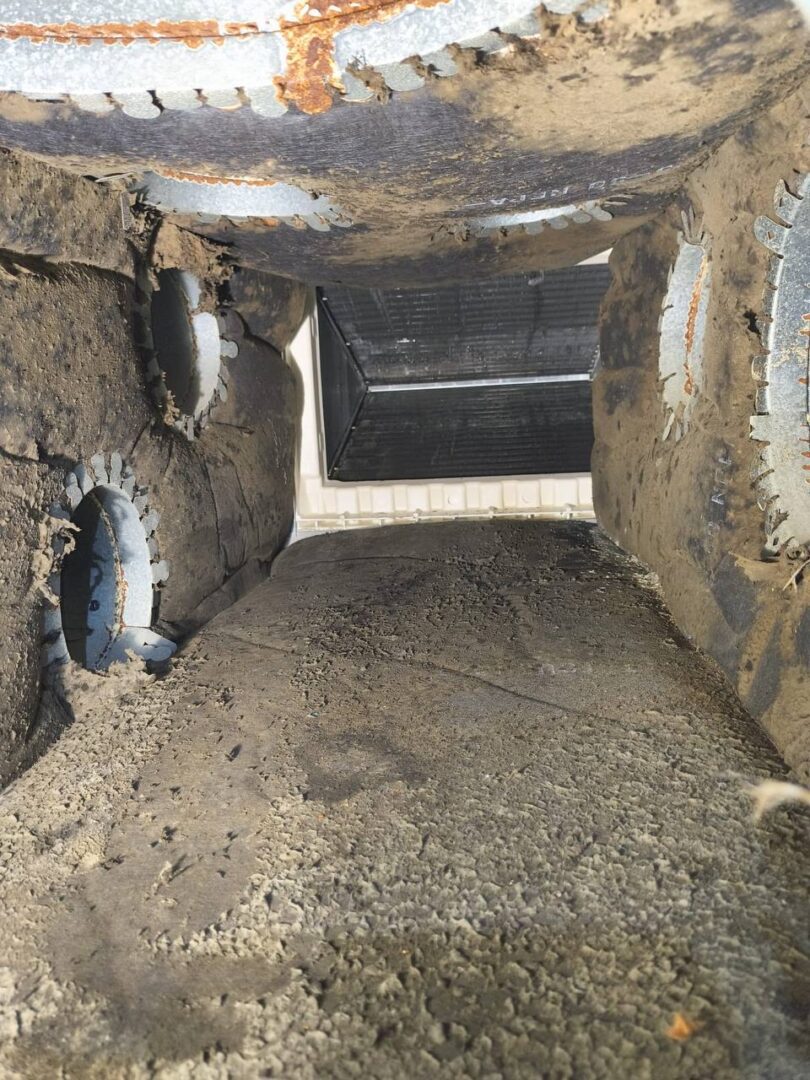
When debris, dust, and microbial growth accumulate inside your supply and return ducts, they restrict airflow. Your blower has to work harder to push the same volume of air through increasingly narrow passages. This increased static pressure forces the blower motor to draw more amperage, generating additional heat and consuming more electricity. On a 100°F day, a system already struggling to cool your home is also fighting against its own blocked ductwork.
3. Restricted Airflow Freezes Evaporator Coils
Poor airflow from dirty ducts doesn’t just waste energy — it can cause your evaporator coil to freeze. When airflow across the coil drops below the manufacturer’s minimum specification, the refrigerant absorbs too much heat too quickly, and condensation freezes on the coil surface. A frozen coil can’t absorb heat effectively, which means your system runs longer and may eventually trigger a safety shutdown — on the hottest day of the year.
4. Heat Soak from Attic Ductwork
Many Houston homes have ductwork running through unconditioned attics where summertime temperatures can exceed 140°F. When ductwork is dirty, the accumulated debris acts as insulation, reducing the effectiveness of the duct insulation that’s already there. Poorly sealed or dirty ducts lose up to 20–30% of conditioned air — cooled air that your system worked hard to produce — into the attic space. This means your AC runs longer to achieve the same indoor temperature.
5. Humidity Overload from Undersized Systems
Houston’s summer humidity means your AC must remove gallons of moisture from your indoor air every day. When ductwork is dirty or leaky, the system can’t properly dehumidify because air isn’t spending enough time in contact with the cooling coil. The result: a cool but clammy home, increased risk of mold growth inside ductwork, and a system that never achieves the dry bulb temperature you’ve set on your thermostat.
6. Increased Energy Bills Every Degree It Gets Hotter
Every degree the outdoor temperature rises above 95°F increases your AC’s energy consumption by approximately 3–5%. When combined with the efficiency losses from dirty ducts (which can add 15–25% to your cooling costs), the financial impact is significant. CenterPoint Energy data shows that Houston homeowners with clean duct systems typically see 15–20% lower summer cooling bills compared to homes with neglected ductwork.
Why Duct Cleaning Is a Summer Performance Strategy
Houston homeowners often think of air duct cleaning as an indoor air quality service — something you do to reduce dust or address allergies. While those are valid benefits, duct cleaning is also a critical HVAC performance strategy in Houston’s extreme climate:
- Restored airflow: Removing debris from supply and return ductwork reduces static pressure, allowing your blower to move air efficiently and your evaporator coil to operate at designed specifications.
- Improved heat transfer: Clean evaporator coils transfer heat more effectively, improving the system’s overall efficiency (SEER rating) and reducing runtime.
- Better humidity control: With proper airflow, your AC can properly dehumidify, keeping your home comfortable at higher thermostat settings — saving energy without sacrificing comfort.
- Reduced strain on components: When airflow is optimized, the compressor, blower motor, and expansion valve operate within their designed ranges, extending their service life through Houston’s brutal summers.
The best time to address duct cleaning for summer performance is before the heat wave arrives — ideally in late spring. But even during summer, cleaning your ducts can reduce the load on your system and improve its ability to keep your home cool.
What NADCA-Certified Duct Cleaning Looks Like
When you schedule professional air duct cleaning with a NADCA-certified contractor like AH-CHOO, the process is designed to restore your duct system to optimal performance:
- Inspection and assessment: A certified technician inspects your entire duct system using remote cameras, documenting the condition of supply and return ducts, the air handler, evaporator coil, and blower wheel.
- Negative air containment: Truck-mounted HEPA-filtered vacuum units create negative pressure in your ductwork, ensuring that dislodged debris is captured and removed — not released into your living space.
- Mechanical agitation: Compressed air tools, rotating brushes, and contact vacuuming dislodge debris from duct surfaces while the negative air system captures it at the source.
- Component-by-component cleaning: Each component — from the evaporator coil and drain pan to the blower wheel, plenum, and register boots — is cleaned individually according to NADCA standards.
- Post-cleaning verification: The technician re-inspects the system to confirm that debris has been removed and airflow is restored to manufacturer specifications.
NADCA Standard ACR 2025 requires source removal — debris must be physically removed from the system, not merely dislodged or encapsulated. This is the only cleaning methodology that restores your HVAC system to its designed performance level.
Signs Your Ducts Are Hurting Your HVAC’s Summer Performance
If you’re experiencing any of these during Houston’s summer, your ductwork may be compromising your system’s performance:
- Your AC runs continuously but never seems to catch up on the hottest days
- Some rooms are noticeably warmer than others — especially rooms farthest from the air handler
- Your energy bill is substantially higher than the same period last year
- You see visible dust accumulating on supply registers within days of dusting
- There’s a musty odor when the AC first turns on
- You’ve never had your ducts cleaned — or it’s been more than 3–5 years
Frequently Asked Questions
Q: How much can duct cleaning reduce my summer cooling costs in Houston?
A: While individual results vary, homeowners with significantly blocked ductwork typically see 15–25% improvement in cooling efficiency after professional cleaning. CenterPoint Energy’s energy efficiency programs recognize duct cleaning as a legitimate HVAC performance measure.
Q: Is duct cleaning worth it for a newer Houston home with a newer HVAC system?
A: Yes — even new construction homes can have construction debris, drywall dust, and insulation fragments in the ductwork. Cleaning ensures your new system operates at its rated efficiency from day one.
Q: How often should Houston homeowners clean their ducts?
A: NADCA recommends inspection every 2–3 years and cleaning when visible debris or microbial growth is present. Houston homes in high-humidity areas or with pets may benefit from more frequent inspection.
Q: Will duct cleaning fix uneven cooling in my Houston home?
A: Duct cleaning alone may not solve all uneven-cooling issues — duct design, insulation, and equipment sizing also play roles. However, cleaning blocked ducts and registers can significantly improve airflow to distant rooms. A professional inspection can identify all contributing factors.
Q: Can dirty ducts cause my AC to freeze up?
A: Yes — restricted airflow from dirty ducts is one of the most common causes of evaporator coil freeze-ups during Houston summers. When airflow drops below spec, the coil temperature drops below freezing, and condensation ice builds up until the system shuts down.
Q: Does duct cleaning help with Houston humidity?
A: Yes — by restoring proper airflow across the evaporator coil, duct cleaning helps your AC system dehumidify more effectively. Better humidity control means you can set your thermostat 2–3°F higher while maintaining the same comfort level, saving energy.
Is your Houston HVAC system struggling to keep up with summer heat? AH-CHOO’s NADCA-certified technicians can inspect and clean your ductwork to restore system performance. Schedule an inspection to get your HVAC ready for Houston’s hottest months.
Learn more about Houston air duct cleaning services or read about how duct cleaning improves HVAC efficiency. For seasonal preparation, see our guide on Houston humidity and seasonal duct maintenance.
Houston homeowners can also explore how often to clean air ducts in Houston and our spring HVAC checklist for summer preparation.