Meta Description: Houston office employees with recurring headaches, fatigue, or respiratory symptoms may be experiencing sick building syndrome. Commercial duct cleaning is often the fix.
“`json
{
“@context”: “https://schema.org”,
“@graph”: [
{
“@type”: “Article”,
“@id”: “https://ahchooindoorair.com/blog/sick-building-syndrome-houston-offices”,
“headline”: “Sick Building Syndrome in Houston: How Commercial Duct Cleaning Helps”,
“description”: “Houston office employees with recurring headaches, fatigue, or respiratory symptoms may be experiencing sick building syndrome. Commercial duct cleaning is often the fix.”,
“url”: “https://ahchooindoorair.com/blog/sick-building-syndrome-houston-offices”,
“datePublished”: “2026-03-26”,
“dateModified”: “2026-03-26”,
“author”: {
“@type”: “Organization”,
“name”: “AH-CHOO! Indoor Air Quality”,
“url”: “https://ahchooindoorair.com”
},
“publisher”: {
“@type”: “Organization”,
“name”: “AH-CHOO! Indoor Air Quality”,
“logo”: {
“@type”: “ImageObject”,
“url”: “https://ahchooindoorair.com/logo.png”
}
}
},
{
“@type”: “FAQPage”,
“mainEntity”: [
{
“@type”: “Question”,
“name”: “What is sick building syndrome?”,
“acceptedAnswer”: {
“@type”: “Answer”,
“text”: “Sick building syndrome (SBS) is a pattern of health complaints — headaches, fatigue, eye and respiratory irritation, difficulty concentrating, and nausea — that appear while occupying a specific building and resolve when people leave. It’s typically caused by a combination of inadequate ventilation, biological contamination, and chemical pollutants inside the building’s air distribution system.”
}
},
{
“@type”: “Question”,
“name”: “How do I know if my Houston office has sick building syndrome?”,
“acceptedAnswer”: {
“@type”: “Answer”,
“text”: “Key indicators include: multiple employees reporting similar symptoms that improve on days away from the office or during work-from-home periods, symptoms that worsen when the HVAC system runs, musty odors in parts of the building, visible mold near vents or on ceiling tiles, and a history of poor HVAC maintenance or water intrusion events.”
}
},
{
“@type”: “Question”,
“name”: “Can a contaminated HVAC system cause sick building syndrome?”,
“acceptedAnswer”: {
“@type”: “Answer”,
“text”: “Yes, and it’s one of the most common causes. Commercial HVAC systems that distribute contaminated air — containing mold spores, accumulated particulate matter, biological growth on duct surfaces, or VOCs from duct materials — affect everyone in the building simultaneously, creating the cluster of similar symptoms that characterizes SBS.”
}
},
{
“@type”: “Question”,
“name”: “How often should commercial ducts be cleaned in Houston?”,
“acceptedAnswer”: {
“@type”: “Answer”,
“text”: “NADCA recommends commercial duct cleaning every 3-5 years, but Houston’s humidity accelerates contamination. High-occupancy buildings, facilities with food service, medical or healthcare spaces, and any building with a history of water intrusion or mold should clean more frequently — every 2-3 years.”
}
},
{
“@type”: “Question”,
“name”: “Does commercial duct cleaning have to shut down the office?”,
“acceptedAnswer”: {
“@type”: “Answer”,
“text”: “Not necessarily. Depending on building layout, commercial duct cleaning can often be scheduled in sections — evenings, weekends, or floor by floor — to minimize operational disruption. Our team works with building management to develop a schedule that gets the system clean without unnecessary downtime.”
}
},
{
“@type”: “Question”,
“name”: “What are the business costs of sick building syndrome?”,
“acceptedAnswer”: {
“@type”: “Answer”,
“text”: “The EPA has estimated that sick building syndrome costs U.S. businesses billions of dollars annually in lost productivity, increased absenteeism, and healthcare costs. Buildings with poor indoor air quality see higher turnover, more sick days, and lower employee performance — all of which translate directly to operational costs.”
}
}
]
}
]
}
“`
You’ve probably seen the pattern: it’s Monday morning, and within an hour of arriving at the office, the headaches start. By afternoon, half the team looks drained. But on work-from-home days, everyone feels fine. At the company offsite, nobody complained of fatigue.
This pattern has a name: sick building syndrome. And in Houston, where commercial buildings run their HVAC systems year-round in a humid climate that accelerates duct contamination, it’s more common than most building managers recognize.
What Sick Building Syndrome Actually Is
Sick building syndrome (SBS) is defined by the World Health Organization as a situation where building occupants experience acute health effects that appear linked to time spent in a building, without a specific identifiable cause being confirmed. The symptoms typically resolve or improve when people leave the building.
Common symptoms include:
- Headaches (often described as pressure or dull aching, not sharp)
- Eye, nose, and throat irritation
- Dry cough and respiratory discomfort
- Fatigue and difficulty concentrating
- Skin irritation (dry or itchy skin)
- Nausea and dizziness in more severe cases
What distinguishes SBS from ordinary illness is the pattern: symptoms that cluster among building occupants, that worsen during building occupancy and improve away from it, and that don’t correspond to a diagnosable disease.
What Causes It in Houston Offices
Building-related illness has multiple contributing factors, but in Houston’s commercial environment, the HVAC system is almost always a central part of the problem.
Contaminated Duct Systems
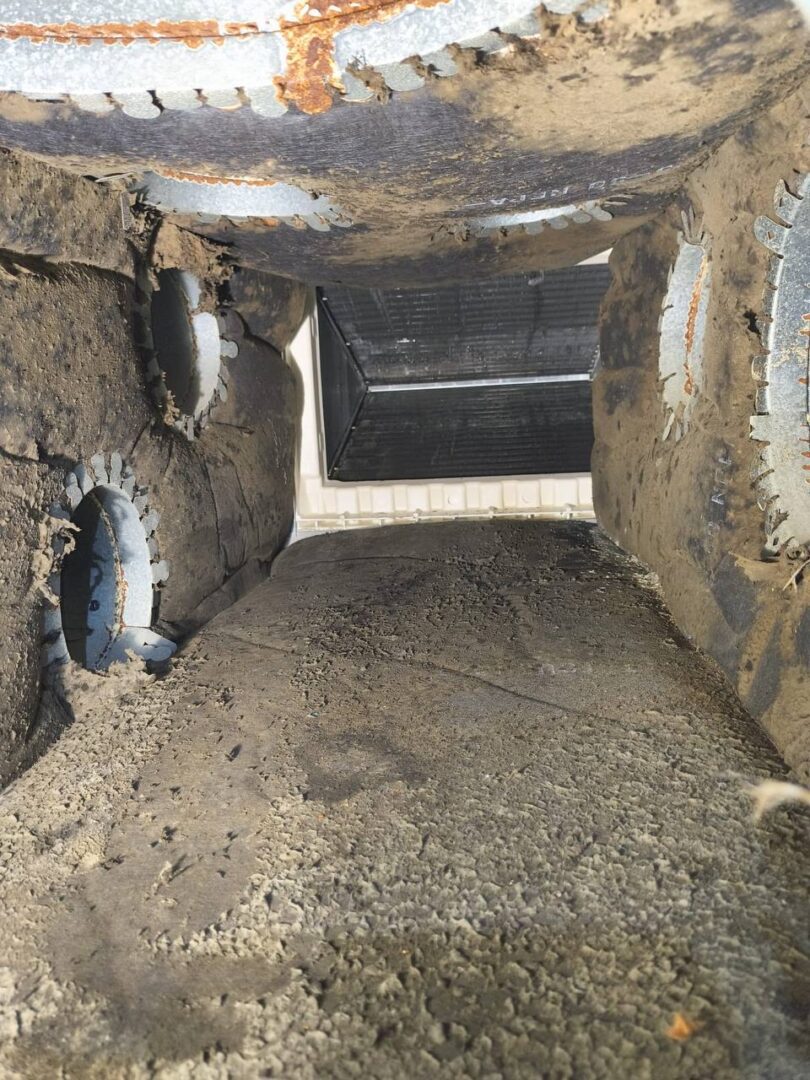
Commercial HVAC duct systems in Houston accumulate the same contaminants as residential systems — mold spores, accumulated particulate matter, biological growth, dust, and debris — but at a much larger scale. Large open-plan offices, conference rooms, break rooms, and common areas all share the same air distribution network.
Houston’s humidity accelerates biological growth inside commercial duct systems significantly. We’ve inspected commercial buildings in downtown Houston and the Energy Corridor where the duct interior surfaces showed significant mold colonization — in some cases visible through inspection camera without needing to open the ducts. These systems were continuously distributing mold spores and particulates to everyone in the building.
Unlike residential systems, commercial duct systems often run 8-12 hours per day, five to six days per week. The continuous operation means continuous distribution of whatever contamination exists inside the system.
Inadequate Ventilation
Commercial buildings are often designed to minimize energy use by limiting outdoor air exchange. This energy efficiency creates an unintended consequence: when contamination exists inside the building’s air system, it recirculates continuously without being diluted by fresh outdoor air. Contaminant concentrations build up over the course of a workday.
The energy efficiency measures that reduce HVAC costs can directly worsen air quality outcomes — a trade-off that building managers rarely consider when making maintenance decisions.
VOCs from Building Materials and Furnishings
New office renovations — new carpet, fresh paint, new furniture, new partition systems — off-gas VOCs for weeks to months. In a tightly sealed commercial building with limited ventilation, these concentrations build up significantly. VOC exposure at elevated levels causes exactly the symptom pattern associated with SBS: headaches, cognitive impairment, irritation, and fatigue.
If your building recently underwent renovation and symptoms appeared shortly after, VOC accumulation combined with inadequate ventilation is a likely contributor.
Moisture Intrusion and Mold
Houston’s building stock is regularly subjected to humidity intrusion, roof leaks, condensation issues, and in post-hurricane situations, significant water damage. Commercial buildings with any history of water intrusion events — leaking roofs, failed building envelope, flooding — are at high risk for mold colonization inside their HVAC systems.
We’ve performed commercial cleanings at Houston offices where a single ceiling water leak from several years prior had spread mold growth through connected duct sections affecting multiple floors. The occupants had been experiencing SBS symptoms for years; building management had attributed it to stress and building age.
The Business Cost of Ignoring It
The temptation in commercial settings is to minimize the problem — especially when it requires disrupting operations and scheduling a cleaning. But the costs of inaction compound.
Productivity loss. The EPA has estimated that poor indoor air quality costs U.S. businesses hundreds of billions in reduced productivity annually. Cognitive performance decreases measurably when people work in elevated CO2 and VOC environments. Headaches and fatigue directly reduce output.
Absenteeism. Employees who develop respiratory symptoms or persistent headaches from building exposure take sick days. In a contaminated building, the absenteeism isn’t random — it follows the exposure pattern.
Turnover and recruitment. Word gets around about sick buildings. Employees who consistently feel unwell at work look for other employment. Talent acquisition becomes harder and more expensive when the building has a reputation.
Liability exposure. Documented sick building syndrome complaints that go unaddressed can create legal liability. Employers have a duty to provide a safe work environment; knowingly maintaining a building with documented air quality problems increases this risk.
How Commercial Duct Cleaning Addresses Sick Building Syndrome
[Commercial duct cleaning](https://ahchooindoorair.com/commercial-duct-cleaning) targets the HVAC system as the primary distribution mechanism for building-wide air quality problems. The NADCA-certified process for commercial systems uses the same high-powered negative air pressure and mechanical agitation approach as residential cleaning, adapted for the scale and complexity of commercial HVAC infrastructure.
What gets addressed:
Main duct trunks: The primary distribution branches that serve entire floors or zones — often the sections with the heaviest accumulation.
Branch runs: Individual ducts serving specific areas or rooms.
Diffusers and grilles: Supply and return outlets that accumulate debris and can be visible sources of contamination.
Air handling units (AHUs): The central units where coils, filters, and blowers are located — often the most contaminated components in a commercial system.
Coil cleaning: Evaporator coils in commercial AHUs accumulate biological growth and debris that significantly affects both air quality and system efficiency.
If mold is found during the cleaning process, [mold remediation](https://ahchooindoorair.com/mold-remediation) is incorporated into the scope. For commercial buildings with confirmed mold, simply cleaning without proper remediation of biological growth doesn’t fully resolve the problem.
Minimizing Operational Disruption
One of the primary objections to commercial duct cleaning is concern about operational disruption. In practice, well-planned commercial cleaning minimizes this:
Sectional scheduling: Large buildings can be cleaned section by section, floor by floor, or zone by zone — allowing partial building operation to continue throughout the process.
Off-hours work: Evening and weekend scheduling keeps cleaning activity out of normal business hours.
Phased approach: For very large buildings, a phased multi-visit cleaning plan spreads work over time while addressing the most critical sections first.
Our team works with building management before the job to develop a schedule that gets the work done without unnecessary disruption to your operations.
Taking Action
If your building shows the pattern of sick building syndrome — multiple employees with similar symptoms that improve away from the building — the HVAC system deserves investigation before other explanations are explored.
The free inspection gives you an honest picture of what’s happening inside the system. In many cases, the contamination we find during commercial inspections is significant enough to make it immediately clear why occupants have been experiencing symptoms.
[Book your free inspection at crm.ahchooindoorair.com/book](https://crm.ahchooindoorair.com/book)
Our NADCA-certified team has 38 years of experience with Houston’s commercial buildings. We’ll tell you what we find — and what it would take to fix it.
Frequently Asked Questions
What is sick building syndrome?
Sick building syndrome (SBS) is a pattern of health complaints — headaches, fatigue, eye and respiratory irritation, difficulty concentrating, and nausea — that appear while occupying a specific building and resolve when people leave. It’s typically caused by a combination of inadequate ventilation, biological contamination, and chemical pollutants inside the building’s air distribution system.
How do I know if my Houston office has sick building syndrome?
Key indicators include: multiple employees reporting similar symptoms that improve on days away from the office or during work-from-home periods, symptoms that worsen when the HVAC system runs, musty odors in parts of the building, visible mold near vents or on ceiling tiles, and a history of poor HVAC maintenance or water intrusion events.
Can a contaminated HVAC system cause sick building syndrome?
Yes, and it’s one of the most common causes. Commercial HVAC systems that distribute contaminated air — containing mold spores, accumulated particulate matter, biological growth on duct surfaces, or VOCs from duct materials — affect everyone in the building simultaneously, creating the cluster of similar symptoms that characterizes SBS.
How often should commercial ducts be cleaned in Houston?
NADCA recommends commercial duct cleaning every 3-5 years, but Houston’s humidity accelerates contamination. High-occupancy buildings, facilities with food service, medical or healthcare spaces, and any building with a history of water intrusion or mold should clean more frequently — every 2-3 years.
Does commercial duct cleaning have to shut down the office?
Not necessarily. Depending on building layout, commercial duct cleaning can often be scheduled in sections — evenings, weekends, or floor by floor — to minimize operational disruption. Our team works with building management to develop a schedule that gets the system clean without unnecessary downtime.
What are the business costs of sick building syndrome?
The EPA has estimated that sick building syndrome costs U.S. businesses billions of dollars annually in lost productivity, increased absenteeism, and healthcare costs. Buildings with poor indoor air quality see higher turnover, more sick days, and lower employee performance — all of which translate directly to operational costs.
Related Service Areas
- Air Quality Evaluation in Houston, TX
- Why Dust Keeps Coming Back in Houston
- Pet Dander Removal from Air Ducts
- Blower Wheel Cleaning for Houston HVAC
Related AH-CHOO resources: Houston air duct cleaning; commercial air duct cleaning; schedule a free inspection.