Meta Description: Dust returns within days of cleaning? Your Houston duct system is the likely source. Learn why dust persists and what actually solves the problem for good.
“`json
{
“@context”: “https://schema.org”,
“@graph”: [
{
“@type”: “Article”,
“@id”: “https://ahchooindoorair.com/blog/dust-keeps-coming-back-houston”,
“headline”: “Why Does Dust Keep Coming Back? What Houston Homeowners Miss”,
“description”: “Dust returns within days of cleaning? Your Houston duct system is the likely source. Learn why dust persists and what actually solves the problem for good.”,
“url”: “https://ahchooindoorair.com/blog/dust-keeps-coming-back-houston”,
“datePublished”: “2026-03-26”,
“dateModified”: “2026-03-26”,
“author”: {
“@type”: “Organization”,
“name”: “AH-CHOO! Indoor Air Quality”,
“url”: “https://ahchooindoorair.com”
},
“publisher”: {
“@type”: “Organization”,
“name”: “AH-CHOO! Indoor Air Quality”,
“logo”: {
“@type”: “ImageObject”,
“url”: “https://ahchooindoorair.com/logo.png”
}
}
},
{
“@type”: “FAQPage”,
“mainEntity”: [
{
“@type”: “Question”,
“name”: “Why does dust come back so quickly after I clean my house?”,
“acceptedAnswer”: {
“@type”: “Answer”,
“text”: “If dust reappears within a day or two of cleaning, your HVAC system is almost certainly redistributing it. The duct system picks up dust from living spaces via return vents and deposits it — along with stored debris — through supply registers. Until the duct system itself is cleaned, surface cleaning alone won’t keep pace.”
}
},
{
“@type”: “Question”,
“name”: “How much dust can accumulate inside Houston ductwork?”,
“acceptedAnswer”: {
“@type”: “Answer”,
“text”: “A typical Houston home that hasn’t had its ducts professionally cleaned in 5+ years can have pounds of accumulated debris inside the duct system. This includes skin cells, pet dander, pollen, insulation fibers, and general particulate matter that builds up in settled layers along duct floors and walls.”
}
},
{
“@type”: “Question”,
“name”: “Does changing my air filter stop dust from coming back?”,
“acceptedAnswer”: {
“@type”: “Answer”,
“text”: “Filter changes slow the rate of accumulation but don’t address debris already inside the duct system. Particles that have settled into duct walls, around register boots, and inside flex duct liners aren’t captured by the filter — they’re re-aerosolized and delivered to living spaces every time the system runs.”
}
},
{
“@type”: “Question”,
“name”: “What is the gray film that appears on walls near vents?”,
“acceptedAnswer”: {
“@type”: “Answer”,
“text”: “The gray or black film that appears on walls around supply registers is called ‘ghosting’ or ‘filtration soiling.’ It’s caused by air carrying fine particles being forced out of registers under pressure, depositing particulate matter on surfaces near the outlet. Heavy ghosting indicates high particle loads in the duct system.”
}
},
{
“@type”: “Question”,
“name”: “Can leaky ducts cause excessive dust in my Houston home?”,
“acceptedAnswer”: {
“@type”: “Answer”,
“text”: “Yes. Leaky ducts in unconditioned spaces like attics pull in unfiltered air — including insulation fibers, outdoor particulates, and whatever else exists in those spaces — and deliver it directly to your living areas. Attic insulation fibers appearing in your home are a classic sign of duct leakage or disconnection.”
}
}
]
}
]
}
“`
You clean your house on Saturday. By Monday, every surface has a visible film of dust again. You clean again. By Wednesday, it’s back. If this is your life, you’ve probably accepted it as normal — a Houston thing, maybe, or just a high-traffic home thing.
It’s not normal. And it’s not inevitable. But the fix doesn’t come from better cleaning products or more frequent cleaning. It comes from addressing the source: your duct system.
The Dust Redistribution Cycle
Every home generates dust. Skin cells, fabric fibers, pollen, pet dander, and outdoor particulates accumulate constantly. In a home without an HVAC system, dust settles and stays until you remove it. In a home with a central air system — which is every home in Houston — dust gets a delivery network.
Here’s the cycle:
1. Dust settles on floors, furniture, and other surfaces
2. Normal activity (walking, sitting, pets moving around) kicks it back into the air
3. Return air vents draw that airborne dust toward the HVAC system
4. The filter catches some of it — but not all
5. What passes through the filter accumulates inside the duct system
6. Each time the system runs, previously settled debris inside the ducts gets partially re-aerosolized
7. Supply registers deliver that re-aerosolized dust to every room in the house
If you’re cleaning surfaces and they’re dusty again in 48 hours, you’re not losing a battle against new dust — you’re battling a recirculation loop. The duct system is constantly reintroducing stored debris.
What’s Actually Inside Houston Ducts
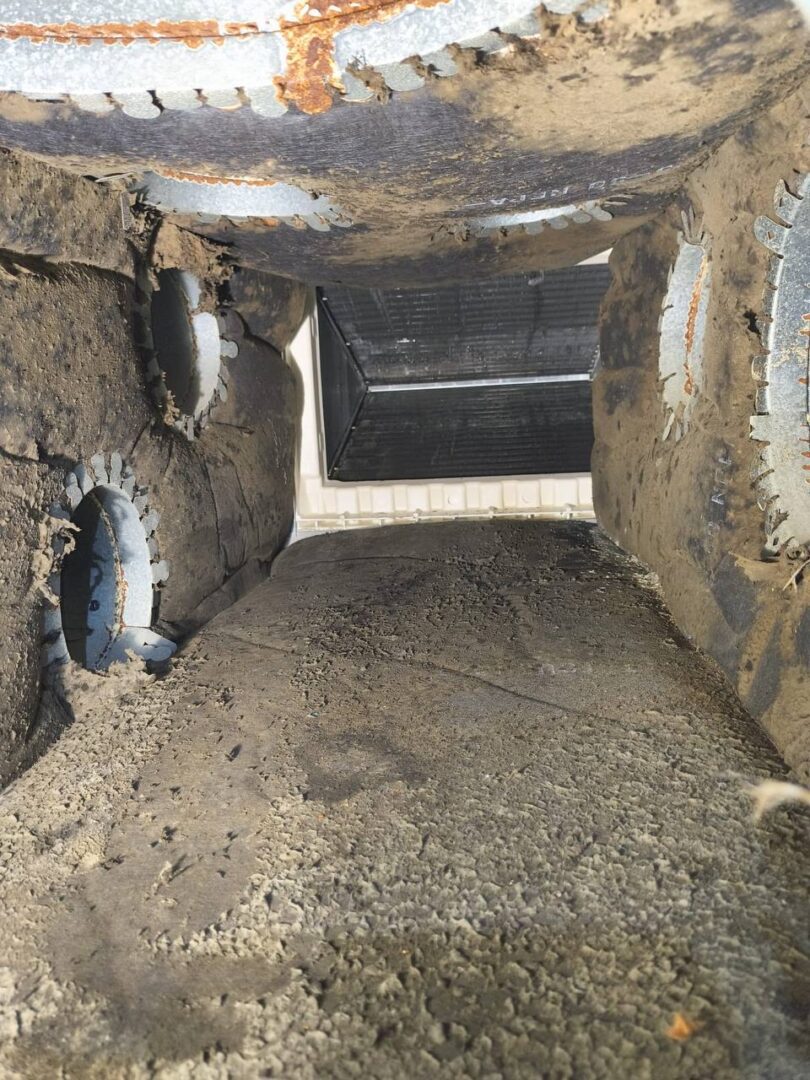
After 38 years of cleaning residential duct systems throughout the Houston area, we have a clear picture of what accumulates. In a home that’s been occupied for several years without professional duct cleaning, the interior of the duct system looks nothing like the clean sheet metal it appeared when it was installed.
Settled Debris Layers
On horizontal duct runs — typically the main trunks running through attics and along ceilings — debris settles and compresses into layers. Fine gray dust is the baseline, but embedded within it are pet hair, insulation fragments, pollen, skin cells, and particles from whatever construction or renovation work happened in or near the home.
In one Friendswood home we cleaned, a horizontal trunk line had debris accumulation thick enough to visibly restrict airflow — the homeowner had been complaining about uneven cooling for years. The problem wasn’t the equipment; it was the debris load.
Register Boot Accumulation
Where the duct terminates at a register boot — the metal box that connects the duct to the ceiling or floor register — debris accumulates heavily. These are natural deposition zones. The air slows as it changes direction, and particles drop out of suspension. When the system runs at higher capacity, that accumulated debris gets pushed out the register into the room.
The Flex Duct Factor
Houston homes built since the 1990s predominantly use flexible duct rather than rigid sheet metal. Flex duct is cost-effective and easy to install, but the corrugated interior creates countless small cavities where debris captures and holds. The flex duct liner material itself generates particulate matter as it ages and flexes.
We regularly see flex duct sections that are visibly narrowed from accumulated debris on the interior walls — a condition that simultaneously reduces airflow efficiency and maintains a large reservoir of material to re-aerosolize continuously.
The Filter Myth
Changing your air filter is important. Nobody disputes this. But the belief that regular filter changes solve the dust-reoccurrence problem misunderstands what filters can and cannot do.
Filters are positioned at the return air intake. They capture particles as they’re being drawn *into* the system from your living space. They have no effect on:
- Debris already deposited inside the duct system upstream of the filter
- Particles that enter through duct leaks, disconnected sections, or gaps at register boots
- Material shed by degrading duct liner or insulation inside the duct system itself
Think of it this way: changing your filter is like cleaning the entrance to a dirty house. It catches some of what comes in going forward, but it does nothing about the mess that’s already inside.
Higher-MERV filters catch finer particles, which is genuinely beneficial. But even a MERV-13 filter doesn’t reach back into your duct system and remove what’s been deposited there over years of operation.
Ghosting: The Visible Symptom
One of the most reliable visible indicators of duct-sourced dust is a phenomenon called “filtration soiling” or ghosting. It appears as gray or dark staining on walls and ceilings near supply registers.
This happens because fine particles suspended in the airstream get deposited on surfaces near the register outlet. Under positive pressure, the supply air hugs wall and ceiling surfaces as it exits the register, and particles fall out of suspension onto those surfaces. The higher the particle load in the duct system, the more pronounced the ghosting.
If you have visible gray streaks or shadowing around your supply registers, your duct system has a significant contamination level. The dust isn’t coming from your candles, your fireplace, or your habits — it’s coming from your ducts.
Leaky Ducts: An Underdiagnosed Source
In Houston, where most ductwork runs through unconditioned attic spaces, duct leakage is an extremely common contributor to dust problems. When duct connections separate, flex duct sections tear, or register boots pull away from the ceiling, the negative pressure inside return ducts begins pulling air from the attic rather than from the conditioned space.
Attic air in Houston contains:
- Loose-fill insulation particles (fiberglass or cellulose)
- Outdoor particulates that infiltrate through attic vents
- In some cases, pest activity byproducts
When attic air enters your duct system, it bypasses your filter entirely. We’ve arrived at homes where homeowners were reporting unusual dust composition — fluffy, fibrous material unlike typical household dust — that turned out to be attic insulation being introduced through a disconnected flex duct. The filter had no ability to address it because the introduction point was downstream of the filter.
A proper [residential duct cleaning](https://ahchooindoorair.com/residential-duct-cleaning) includes inspection of the complete duct system, identifying leakage points and disconnections that need to be sealed before they continue contributing to your dust problem.
What Professional Cleaning Actually Removes
The NADCA-certified cleaning process uses negative air pressure combined with mechanical agitation to physically dislodge and extract debris from the entire duct system — not just accessible surfaces.
The process reaches:
- All supply ducts, from the plenum to each register boot
- All return ducts, from each intake grille to the air handler
- The air handler itself, including the blower wheel and accessible coil area
- Flexible duct sections, using specialized agitation tools designed for the corrugated interior
After a thorough cleaning on a system that’s been neglected for several years, it’s common to remove multiple pounds of debris. The difference in surface dust accumulation rates after cleaning is typically noticeable within the first week.
For buildings with larger, more complex systems, [commercial duct cleaning](https://ahchooindoorair.com/commercial-duct-cleaning) follows the same rigorous approach adapted to the scale of the system.
If biological contamination is found during the cleaning process, [mold remediation](https://ahchooindoorair.com/mold-remediation) can be incorporated to address growth on duct surfaces — which is itself a significant source of fine particulate matter beyond ordinary dust.
What to Expect After Cleaning
Immediately after cleaning, there’s often a brief period of elevated surface dust as fine particles that were loosened but not fully extracted during the process settle out. This typically clears within 24-48 hours.
After that settling period, homeowners consistently report:
- Significantly longer intervals before surfaces visibly re-dust
- Reduced frequency of the “layer of gray” appearance
- Less visible activity at supply registers
- Reduced frequency of ghosting near vents
If your experience has been that no amount of cleaning keeps your home dust-free for more than a day or two, the duct system is almost certainly the reason. The good news is that it’s a solvable problem.
[Book your free inspection at crm.ahchooindoorair.com/book](https://crm.ahchooindoorair.com/book)
Our NADCA-certified team will inspect your duct system and show you exactly what’s contributing to your dust problem — at no cost to you.
Frequently Asked Questions
Why does dust come back so quickly after I clean my house?
If dust reappears within a day or two of cleaning, your HVAC system is almost certainly redistributing it. The duct system picks up dust from living spaces via return vents and deposits it — along with stored debris — through supply registers. Until the duct system itself is cleaned, surface cleaning alone won’t keep pace.
How much dust can accumulate inside Houston ductwork?
A typical Houston home that hasn’t had its ducts professionally cleaned in 5+ years can have pounds of accumulated debris inside the duct system. This includes skin cells, pet dander, pollen, insulation fibers, and general particulate matter that builds up in settled layers along duct floors and walls.
Does changing my air filter stop dust from coming back?
Filter changes slow the rate of accumulation but don’t address debris already inside the duct system. Particles that have settled into duct walls, around register boots, and inside flex duct liners aren’t captured by the filter — they’re re-aerosolized and delivered to living spaces every time the system runs.
What is the gray film that appears on walls near vents?
The gray or black film that appears on walls around supply registers is called ‘ghosting’ or ‘filtration soiling.’ It’s caused by air carrying fine particles being forced out of registers under pressure, depositing particulate matter on surfaces near the outlet. Heavy ghosting indicates high particle loads in the duct system.
Can leaky ducts cause excessive dust in my Houston home?
Yes. Leaky ducts in unconditioned spaces like attics pull in unfiltered air — including insulation fibers, outdoor particulates, and whatever else exists in those spaces — and deliver it directly to your living areas. Attic insulation fibers appearing in your home are a classic sign of duct leakage or disconnection.
Related AH-CHOO resources: Houston air duct cleaning; schedule a free inspection.