Meta Description: Air quality testing in Houston exposes hidden duct contamination. Learn what tests reveal, what results mean, and when professional duct cleaning is the solution.
“`json
{
“@context”: “https://schema.org”,
“@graph”: [
{
“@type”: “Article”,
“@id”: “https://ahchooindoorair.com/blog/air-quality-testing-houston-tx”,
“headline”: “Air Quality Testing in Houston: What It Reveals About Your Ducts”,
“description”: “Air quality testing in Houston exposes hidden duct contamination. Learn what tests reveal, what results mean, and when professional duct cleaning is the solution.”,
“url”: “https://ahchooindoorair.com/blog/air-quality-testing-houston-tx”,
“datePublished”: “2026-03-26”,
“dateModified”: “2026-03-26”,
“author”: {
“@type”: “Organization”,
“name”: “AH-CHOO! Indoor Air Quality”,
“url”: “https://ahchooindoorair.com”
},
“publisher”: {
“@type”: “Organization”,
“name”: “AH-CHOO! Indoor Air Quality”,
“logo”: {
“@type”: “ImageObject”,
“url”: “https://ahchooindoorair.com/logo.png”
}
}
},
{
“@type”: “FAQPage”,
“mainEntity”: [
{
“@type”: “Question”,
“name”: “What does air quality testing reveal about my duct system?”,
“acceptedAnswer”: {
“@type”: “Answer”,
“text”: “Air quality testing can detect mold spore counts, particulate matter levels, VOC concentrations, allergen loads, and biological contaminants. When results are elevated, duct systems are often the primary distribution channel — testing helps confirm whether your HVAC is the source.”
}
},
{
“@type”: “Question”,
“name”: “Should I test air quality before or after duct cleaning?”,
“acceptedAnswer”: {
“@type”: “Answer”,
“text”: “Both. A pre-cleaning test establishes your baseline and identifies which contaminants are present. A post-cleaning test confirms the remediation was successful. This before/after comparison gives you documented proof that your indoor environment improved.”
}
},
{
“@type”: “Question”,
“name”: “How do I know if my ducts are the source of air quality problems?”,
“acceptedAnswer”: {
“@type”: “Answer”,
“text”: “Key indicators include: symptoms that improve when you leave home, musty odors when the AC runs, dust accumulation on registers, elevated particle counts near supply vents, and a history of water intrusion or pest activity. A visual duct inspection combined with air testing provides the clearest picture.”
}
},
{
“@type”: “Question”,
“name”: “What mold spore count is dangerous in Houston homes?”,
“acceptedAnswer”: {
“@type”: “Answer”,
“text”: “Indoor mold spore counts should generally be lower than outdoor counts, and ideally below 500 spores per cubic meter. Houston’s outdoor baseline is already elevated due to humidity, so indoor levels consistently above 1,000 spores per cubic meter — especially of water-damage indicator species — warrant professional investigation.”
}
},
{
“@type”: “Question”,
“name”: “Can a duct inspection replace air quality testing?”,
“acceptedAnswer”: {
“@type”: “Answer”,
“text”: “A duct inspection is often the more practical first step. An experienced NADCA-certified technician can visually assess contamination levels, identify mold growth, and evaluate debris buildup — providing actionable information without laboratory testing costs. Air quality testing adds quantitative data for cases where confirmation is needed.”
}
}
]
}
]
}
“`
When something’s off with the air in your Houston home — persistent stuffiness, mystery sneezing, odors that come and go with the AC — your first instinct might be to test the air itself. Air quality testing is a legitimate tool. But most Houston homeowners don’t fully understand what those tests reveal, what they miss, and how the results connect back to their duct system.
Here’s what you need to know.
What Air Quality Testing Actually Measures
Air quality testing is not one test — it’s a category of tests, each targeting different pollutants. Understanding what each measures helps you know which ones are worth running and what the results mean.
Particle Count Testing
Particle counters measure how many particles of various sizes are suspended in your air at a given moment. Results are reported in particles per cubic foot or per liter across size ranges — typically 0.3, 0.5, 1.0, 2.5, and 10 microns.
Larger particles (10 microns) are the visible dust you see in a sunbeam. Smaller particles (0.3-2.5 microns) are the ones that penetrate deepest into your respiratory system and do the most biological damage. High fine-particle counts in your home almost always point to a distribution source — and your duct system is the primary suspect.
Mold Spore Testing
Mold spore testing involves collecting air samples, culturing them, and counting spore concentrations by species. In Houston, with our chronic humidity issues, mold testing is among the most relevant tests you can run.
The key comparison isn’t just indoor levels in isolation — it’s indoor levels *versus* outdoor levels. If your indoor mold count is higher than what’s measured outside, contamination is being generated or amplified inside your home. Duct systems are a primary amplification point.
What we find during cleaning frequently confirms what air tests suggest: the flex duct liner material acts like a sponge, retaining moisture and feeding mold colonies that then shed spores into the airstream continuously.
VOC Testing
Volatile organic compounds off-gas from paints, flooring adhesives, furniture, cleaning products, and building materials. VOC testing detects the concentration of these compounds in your air. While duct systems aren’t typically a VOC *source*, they can distribute compounds that off-gas from materials inside the duct system itself — particularly older fiberglass duct board or certain duct sealants.
Allergen Testing
Specialized tests can detect concentrations of specific allergens — dust mite proteins, cat and dog dander, cockroach proteins, and pollen. These are the tests most relevant to families dealing with allergy or asthma symptoms. High allergen loads combined with an underperforming HVAC system point directly to duct cleaning as a primary intervention.
What Air Testing Doesn’t Tell You
Air quality tests give you a snapshot — a measurement of what’s in the air at a specific moment. They don’t tell you *where* the contamination is coming from or *why* levels are elevated.
That’s where duct inspection becomes critical.
The Duct System as a Distribution Network
Think of your ducts as blood vessels. Whatever is inside them gets delivered to every room in your home. Air quality testing might reveal elevated mold spore counts, but it takes a physical inspection to determine whether the source is a damp bathroom wall, a crawl space issue, or contamination that’s colonized your duct liner.
After 38 years of inspecting Houston duct systems, we’ve learned to read the signs before testing even begins. Certain patterns consistently indicate duct-sourced contamination:
- Particle counts that are *higher* near supply registers than in the center of a room (contamination is being actively pushed out)
- Mold species that are particularly associated with fiberglass and cellulose (materials used in flex duct construction)
- Allergen levels that remain high even after exterior windows and doors are kept closed
The Timing Problem
Air quality tests reflect conditions at the moment of testing. Duct contamination is often intermittent — levels spike when the system runs and settle between cycles. A test taken while the system is off may underreport the problem significantly. Proper testing should be conducted while the HVAC system is actively running.
What a Houston Duct Inspection Reveals
A professional duct inspection can often answer the questions that air quality testing raises. Our NADCA-certified technicians use inspection cameras and direct visual assessment to evaluate:
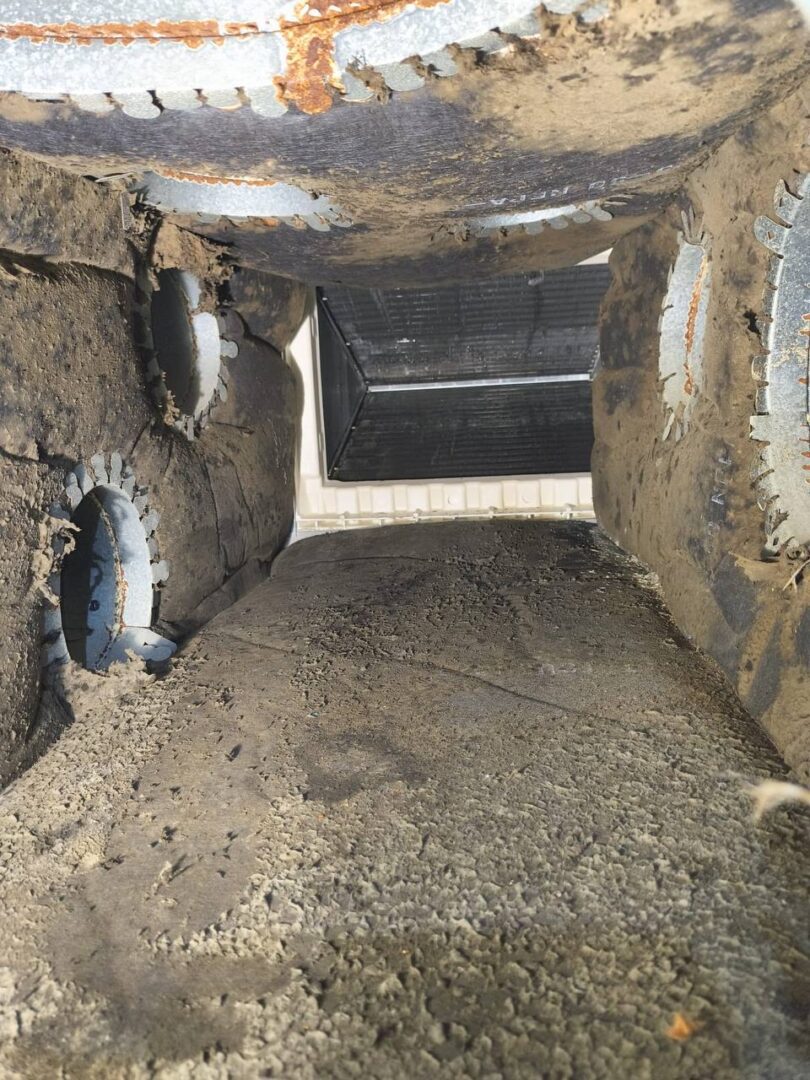
Debris accumulation: The thickness and character of debris on duct walls. Fine gray dust is typical accumulation. Black or green deposits suggest biological growth. Fibrous debris indicates insulation breakdown.
Moisture evidence: Rust staining, swelling of flex duct liner, dark streaking at register boots — all indicate moisture intrusion that creates mold-favorable conditions.
Biological growth: Active mold colonies on duct walls, inside flex duct sections, or at the air handler. In Houston’s climate, this is not unusual — we find it in a meaningful percentage of homes that haven’t been cleaned in five or more years.
System integrity: Disconnected ducts, torn flex sections, and gaps at register boots allow unfiltered air from attics, crawl spaces, and wall cavities to enter the system. This unfiltered air bypasses your filter entirely and introduces outdoor contaminants directly.
One job in Katy revealed a completely disconnected flex duct section in the attic that had been open for years — the system was actively pulling in unfiltered attic air, complete with insulation fibers and rodent droppings, and delivering it to the living space below.
When Testing Points to Duct Cleaning
Certain test results reliably indicate that [residential duct cleaning](https://ahchooindoorair.com/residential-duct-cleaning) is the appropriate intervention:
Elevated mold counts with indoor-higher-than-outdoor ratios: If your indoor mold is worse than the air outside, something inside your home is generating or concentrating it. Duct systems are the most common culprit.
High particle counts near supply registers: Active contamination being pushed out of the duct system shows up clearly in localized particle monitoring.
Allergen levels inconsistent with exterior exposure: If you’re seeing high dust mite or pet dander levels in rooms where pets don’t go, your duct system is redistributing those allergens from other areas of the home.
VOCs that don’t match obvious sources: Certain VOC profiles suggest contamination from within the duct system rather than from surface materials in the room.
When mold is confirmed through testing, the response should address both the duct system and any underlying source. Our [mold remediation services](https://ahchooindoorair.com/mold-remediation) are designed to handle confirmed mold growth comprehensively — not just surface-level treatment.
For commercial properties where air quality affects employee health and productivity, [commercial duct cleaning](https://ahchooindoorair.com/commercial-duct-cleaning) combined with post-remediation testing provides documented evidence of improvement.
The Before/After Testing Approach
The most valuable use of air quality testing is the comparative approach: test before cleaning, then test again after. This gives you documented evidence that the intervention worked — a meaningful data point for homeowners with severe allergies, families with infants, or anyone making a health-based investment.
Here’s what this typically looks like in practice:
1. Initial inspection and baseline air quality measurement
2. Professional duct cleaning (approximately 7 hours for a complete system)
3. Post-cleaning air quality measurement, typically 24-48 hours after cleaning
4. Comparison of results with documentation
Mold spore counts frequently drop significantly after thorough cleaning. Particle counts near registers — which can be dramatically elevated in contaminated systems — typically normalize quickly.
The Practical Starting Point
For most Houston homeowners, a professional duct inspection is the most practical and informative first step. It gives you direct visual evidence of what’s happening inside your system without the cost of laboratory testing. If the inspection reveals contamination that warrants intervention, you address it. If specific health concerns require quantified documentation, testing can follow.
Either way, the starting point is the same.
[Book your free inspection at crm.ahchooindoorair.com/book](https://crm.ahchooindoorair.com/book)
Our NADCA-certified team will assess your duct system and give you an honest, experience-based evaluation of what we find — no guesswork, no upselling, just an accurate picture of your home’s indoor air quality situation.
Frequently Asked Questions
What does air quality testing reveal about my duct system?
Air quality testing can detect mold spore counts, particulate matter levels, VOC concentrations, allergen loads, and biological contaminants. When results are elevated, duct systems are often the primary distribution channel — testing helps confirm whether your HVAC is the source.
Should I test air quality before or after duct cleaning?
Both. A pre-cleaning test establishes your baseline and identifies which contaminants are present. A post-cleaning test confirms the remediation was successful. This before/after comparison gives you documented proof that your indoor environment improved.
How do I know if my ducts are the source of air quality problems?
Key indicators include: symptoms that improve when you leave home, musty odors when the AC runs, dust accumulation on registers, elevated particle counts near supply vents, and a history of water intrusion or pest activity. A visual duct inspection combined with air testing provides the clearest picture.
What mold spore count is dangerous in Houston homes?
Indoor mold spore counts should generally be lower than outdoor counts, and ideally below 500 spores per cubic meter. Houston’s outdoor baseline is already elevated due to humidity, so indoor levels consistently above 1,000 spores per cubic meter — especially of water-damage indicator species — warrant professional investigation.
Can a duct inspection replace air quality testing?
A duct inspection is often the more practical first step. An experienced NADCA-certified technician can visually assess contamination levels, identify mold growth, and evaluate debris buildup — providing actionable information without laboratory testing costs. Air quality testing adds quantitative data for cases where confirmation is needed.
Related Service Areas
- Restaurant HVAC Cleaning Requirements in Texas
- Sick Building Syndrome in Houston Offices
- Why Dust Keeps Coming Back in Houston
- Pet Dander Removal from Air Ducts
Related AH-CHOO resources: Houston air duct cleaning; schedule a free inspection.