Meta Description: Houston homeowners face unique indoor air quality challenges. Learn what’s contaminating your air, health warning signs, and how professional duct cleaning solves the problem.
“`json
{
“@context”: “https://schema.org”,
“@graph”: [
{
“@type”: “Article”,
“@id”: “https://ahchooindoorair.com/blog/indoor-air-quality-houston-guide”,
“headline”: “Indoor Air Quality Houston: The Complete Guide for Homeowners”,
“description”: “Houston homeowners face unique indoor air quality challenges. Learn what’s contaminating your air, health warning signs, and how professional duct cleaning solves the problem.”,
“url”: “https://ahchooindoorair.com/blog/indoor-air-quality-houston-guide”,
“datePublished”: “2026-03-26”,
“dateModified”: “2026-03-26”,
“author”: {
“@type”: “Organization”,
“name”: “AH-CHOO! Indoor Air Quality”,
“url”: “https://ahchooindoorair.com”
},
“publisher”: {
“@type”: “Organization”,
“name”: “AH-CHOO! Indoor Air Quality”,
“logo”: {
“@type”: “ImageObject”,
“url”: “https://ahchooindoorair.com/logo.png”
}
}
},
{
“@type”: “FAQPage”,
“mainEntity”: [
{
“@type”: “Question”,
“name”: “How does Houston’s climate affect indoor air quality?”,
“acceptedAnswer”: {
“@type”: “Answer”,
“text”: “Houston’s high humidity (averaging 75%+) creates ideal conditions for mold growth and dust mite proliferation inside duct systems. The long AC season means ducts run almost year-round, continuously circulating whatever contaminants have built up inside them.”
}
},
{
“@type”: “Question”,
“name”: “What are the most common indoor air pollutants in Houston homes?”,
“acceptedAnswer”: {
“@type”: “Answer”,
“text”: “The most common pollutants include mold spores from humidity-laden ducts, dust mite allergens, pet dander, pollen tracked in from outside, VOCs from building materials, and particulate matter that accumulates inside ductwork over years of use.”
}
},
{
“@type”: “Question”,
“name”: “How often should Houston homeowners have their ducts cleaned?”,
“acceptedAnswer”: {
“@type”: “Answer”,
“text”: “NADCA recommends every 3-5 years under normal conditions, but Houston’s climate typically warrants more frequent cleaning — especially in homes with pets, allergy sufferers, or visible mold. Homes that run AC 10+ months per year accumulate debris faster.”
}
},
{
“@type”: “Question”,
“name”: “Can dirty ducts make my family sick?”,
“acceptedAnswer”: {
“@type”: “Answer”,
“text”: “Yes. Contaminated ducts recirculate allergens, mold spores, and bacteria through your living space every time your HVAC system runs. Symptoms like persistent coughing, worsening allergies, headaches, and fatigue can all trace back to poor indoor air quality.”
}
},
{
“@type”: “Question”,
“name”: “What does professional duct cleaning involve?”,
“acceptedAnswer”: {
“@type”: “Answer”,
“text”: “A professional NADCA-certified duct cleaning uses negative air pressure (powerful vacuum equipment) combined with agitation tools to dislodge and remove contaminants from every section of your duct system. A thorough job typically takes around 7 hours for a complete residential system.”
}
}
]
}
]
}
“`
Houston has a lot going for it — world-class food, no state income tax, a booming economy. But it also has one of the most challenging climates in the country for indoor air quality. Between the relentless humidity, the long air conditioning season, and the year-round allergen load, Houston homeowners are fighting a battle they often don’t know they’re losing — inside their own homes.
This guide covers everything you need to know about indoor air quality in Houston: what’s making it bad, what it does to your health, and what actually fixes it.
Why Houston Is a Unique Indoor Air Quality Challenge
Most cities deal with outdoor air pollution. Houston homeowners deal with that *plus* an indoor air problem that’s shaped entirely by the local climate.
The Humidity Factor
Houston averages humidity above 70% year-round. Inside your ductwork, where condensation forms regularly around cooling coils and where air movement slows to a near-stop when your system cycles off, that humidity creates a perfect breeding environment. Mold can colonize the interior surfaces of ducts, flex duct liners, and the air handler itself without any visible sign from outside.
When your AC kicks on, it pushes air through those contaminated passages and distributes whatever’s growing inside throughout every room in your home.
The Year-Round AC Season
Most of the country gets a natural break in HVAC use during spring and fall. Houston doesn’t. Our AC season runs roughly 10 months, which means your ducts are actively moving air — and actively accumulating debris — almost constantly. A duct system that might need cleaning every five years in Minnesota may need attention every two to three years in Houston simply because of run-time.
The Allergen Load
Houston is consistently ranked among the worst cities in the country for allergies. Mountain cedar, oak, ragweed, and mold spores enter the home every time a door opens, and they accumulate inside duct systems where filtration is imperfect. Homes near bayous, construction zones, or heavily wooded areas face even higher particulate loads.
What’s Actually Inside Your Ducts
After 38 years of cleaning duct systems across the Houston area, our NADCA-certified technicians have seen it all. Here’s what we find most commonly:
Accumulated Debris Layers
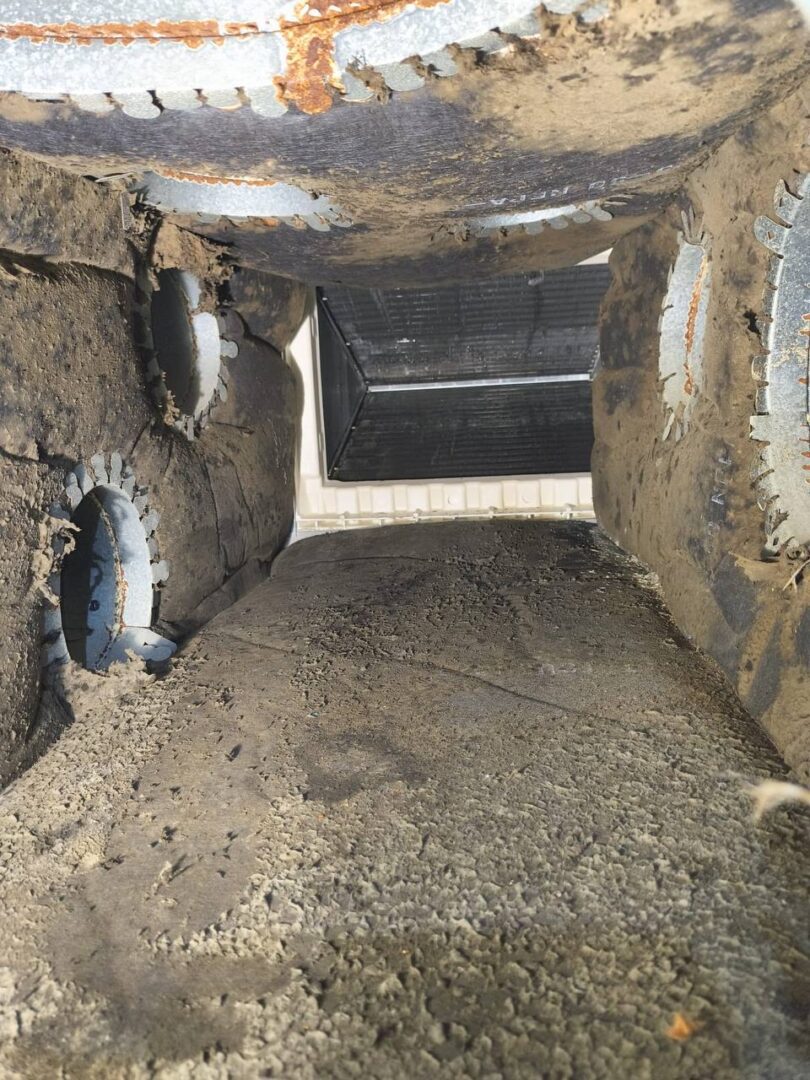
A duct system that hasn’t been professionally cleaned will typically have layers of settled debris — dust, skin cells, insulation fibers, and general particulate matter — coating the interior walls. In older systems, these layers can be a quarter-inch thick or more. Every time your blower runs, it disturbs these deposits and sends them into your living space.
Mold Colonies
Visible mold inside ducts is more common in Houston than anywhere else we’ve worked. We frequently find active mold growth in flex duct systems, near supply registers where condensation collects, and around poorly insulated sections of ductwork in unconditioned spaces like attics. One job in the Heights revealed mold growth that had spread from a single flex duct elbow through nearly 40 feet of connected supply runs — entirely invisible from the registers.
Pest Evidence
Rodents and insects regularly enter duct systems through gaps in connections, torn flex duct, or unsecured register boots. We find nesting materials, droppings, and insect casings in a significant percentage of Houston homes. These aren’t just unpleasant — rodent droppings are a known allergen and can trigger severe respiratory reactions.
Construction Debris
In homes less than ten years old, we commonly find drywall dust, insulation fragments, and sawdust that was never removed after construction. Builders seal up homes before duct systems are cleaned, and that material circulates indefinitely until a professional removes it.
Health Effects of Poor Indoor Air Quality
The EPA estimates that indoor air is 2-5 times more polluted than outdoor air on average. In Houston, with our elevated humidity and long HVAC season, that ratio can be even worse. Here’s what contaminated indoor air does to your health:
Respiratory Symptoms
The most immediate effects are respiratory: chronic coughing, wheezing, nasal congestion, and throat irritation that seems to appear out of nowhere. Houston homeowners often blame outdoor allergies when the real source is inside their own duct system.
Allergy and Asthma Flares
Mold spores and dust mite allergens are two of the most potent triggers for both allergies and asthma. A contaminated duct system continuously delivers these triggers directly to where you sleep, eat, and spend most of your time. Children and elderly residents are particularly vulnerable.
Headaches and Fatigue
VOCs — volatile organic compounds off-gassed from building materials, cleaning products, and furnishings — accumulate in poorly ventilated indoor spaces. When those compounds are also being circulated through duct systems, residents experience persistent low-grade symptoms like headaches, brain fog, and unexplained fatigue.
Long-Term Effects
Chronic exposure to indoor air pollutants is linked to increased rates of respiratory disease, cardiovascular issues, and compromised immune function. For vulnerable populations — infants, the elderly, and those with existing conditions — the stakes are higher still.
The Role Your HVAC System Plays
Your HVAC system is either your best defense against indoor air pollution or your biggest source of it. The difference comes down to maintenance.
Filters Are Not Enough
A standard 1-inch pleated filter catches a fraction of the particles circulating in your air. Finer particles — the ones most likely to reach your lungs — pass right through. And filters do nothing about contamination that’s already built up on duct walls, in flex duct liners, or inside the air handler itself.
The Air Handler Is Often Overlooked
Most homeowners think about their ducts but forget the air handler — the unit that contains the blower, coil, and heat exchanger. We regularly find the worst contamination concentrated here. The evaporator coil is a magnet for biological growth because it’s constantly wet. A dirty coil doesn’t just affect air quality; it reduces system efficiency significantly.
Return Air Ducts vs. Supply Ducts
Both sides of your duct system need attention, and many cleaning companies skip the return side. Return ducts pull air back to the air handler for reconditioning — if they’re contaminated, everything going through them is contaminated too. Our process addresses the complete system, not just the easy-to-reach supply registers.
What Professional Duct Cleaning Actually Does
This is where [residential duct cleaning](https://ahchooindoorair.com/residential-duct-cleaning) differs from the discount services you see advertised. A proper NADCA-certified cleaning is a full-day process — approximately 7 hours for a complete residential system.
The process uses high-powered negative air pressure to create a controlled vacuum throughout the duct system while mechanical agitation tools dislodge debris from duct walls. Everything captured is contained and removed from your home. Access points are carefully sealed after the work is complete.
If mold is found during the cleaning process, our team can address it directly through [mold remediation services](https://ahchooindoorair.com/mold-remediation) — ensuring the source of contamination is treated, not just temporarily cleared.
For businesses dealing with the same issues at a larger scale, [commercial duct cleaning](https://ahchooindoorair.com/commercial-duct-cleaning) follows the same rigorous process adapted for larger systems.
Signs Your Houston Home Needs Duct Cleaning Now
- Dust reappears on surfaces within days of cleaning
- Family members have worsening allergies or respiratory symptoms indoors
- Musty or stale odors when the AC runs
- Visible debris blowing from registers
- You’ve never had the ducts professionally cleaned
- Recent construction, renovation, or water intrusion event
- A pest infestation was recently treated
Take the Next Step
Indoor air quality is invisible — which is why it’s easy to ignore. But the effects are very real, and Houston’s climate means the problem compounds faster than most homeowners expect.
The best first step is a free inspection. Our NADCA-certified team will assess your duct system, identify contamination levels, and give you an honest picture of what’s happening inside your home’s air delivery system.
[Book your free inspection at crm.ahchooindoorair.com/book](https://crm.ahchooindoorair.com/book)
Frequently Asked Questions
How does Houston’s climate affect indoor air quality?
Houston’s high humidity (averaging 75%+) creates ideal conditions for mold growth and dust mite proliferation inside duct systems. The long AC season means ducts run almost year-round, continuously circulating whatever contaminants have built up inside them.
What are the most common indoor air pollutants in Houston homes?
The most common pollutants include mold spores from humidity-laden ducts, dust mite allergens, pet dander, pollen tracked in from outside, VOCs from building materials, and particulate matter that accumulates inside ductwork over years of use.
How often should Houston homeowners have their ducts cleaned?
NADCA recommends every 3-5 years under normal conditions, but Houston’s climate typically warrants more frequent cleaning — especially in homes with pets, allergy sufferers, or visible mold. Homes that run AC 10+ months per year accumulate debris faster.
Can dirty ducts make my family sick?
Yes. Contaminated ducts recirculate allergens, mold spores, and bacteria through your living space every time your HVAC system runs. Symptoms like persistent coughing, worsening allergies, headaches, and fatigue can all trace back to poor indoor air quality.
What does professional duct cleaning involve?
A professional NADCA-certified duct cleaning uses negative air pressure (powerful vacuum equipment) combined with agitation tools to dislodge and remove contaminants from every section of your duct system. A thorough job typically takes around 7 hours for a complete residential system.
Related Service Areas
- Why Allergies Get Worse Indoors in Houston
- Indoor Allergies in Houston — What You Can Do
- Asthma and Indoor Air Quality in Texas
- Baby Nursery Air Quality in Houston
Related AH-CHOO resources: Houston air duct cleaning; schedule a free inspection.