# The 8 HVAC Components We Clean (And Why Each One Matters)
When you Google “air duct cleaning,” most companies describe the service as “cleaning your ducts.” That description is incomplete — and deliberately so. Your HVAC system isn’t just ducts. It’s a chain of 8 components that work together to move, filter, heat, and cool the air in your home. When any one of those 8 components is dirty, the entire system circulates contaminated air.
At AH-CHOO! Indoor Air Quality, we don’t clean ducts. We clean the entire air-moving system. That means all 8 components, every single job. Here’s the complete breakdown, why each one matters, and what happens when you skip any of them.
1. Return Air Ducts
What they do: Pull air from every room back to your HVAC system’s air handler.
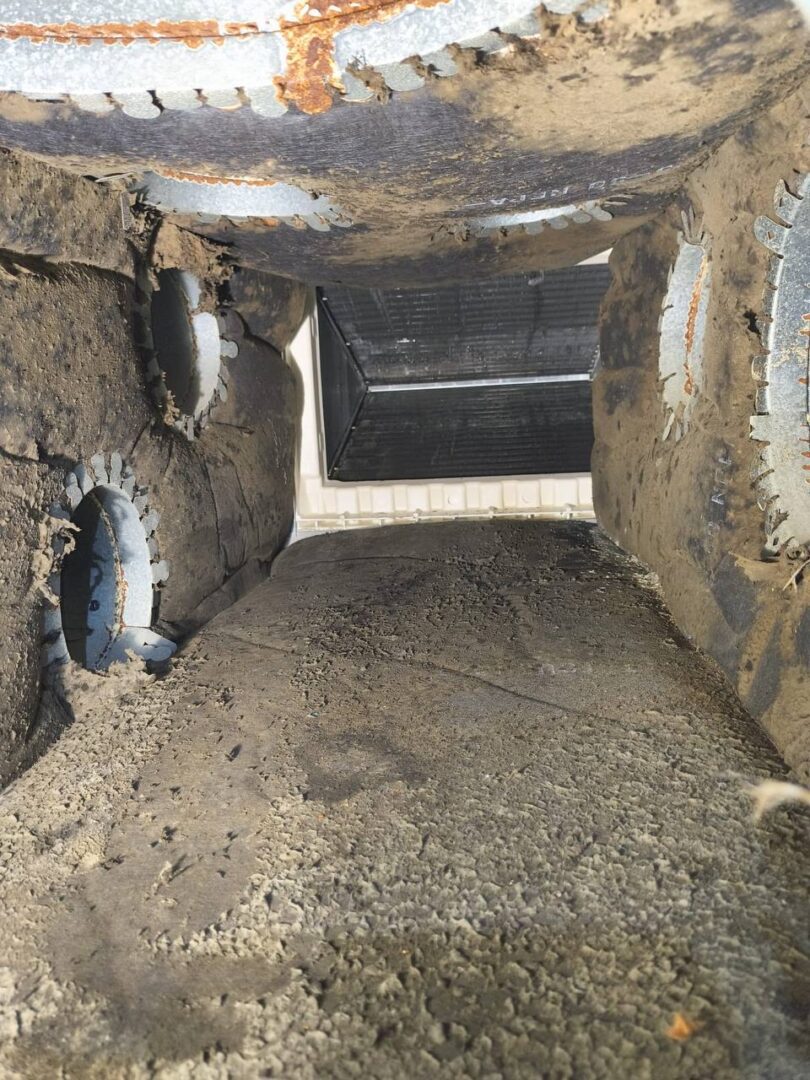
What accumulates: Dust, pet dander, pollen, lint, and every airborne particle in your home settles inside return duct surfaces over time. Returns are the largest intake in your home — often 20-30 inches in diameter — and they’ve been pulling air through the same interior duct walls for years.
Why it matters: Every time your system cycles, air passes through these contaminated walls and picks up accumulated debris. If you’ve ever turned on your HVAC and thought “something smells dusty,” the return ducts are likely the source. We’ve found return ducts in Houston homes so heavily coated with compacted debris that the internal diameter was reduced by half.
Our approach: Each return duct receives individual mechanical agitation with rotary brushes and compressed air tools, paired with negative pressure capture from our truck-mounted vacuum system. We access every return — not just the main return near the air handler.
2. Evaporator Coils
What they do: Cool and dehumidify the air that passes through them during A/C cycles.
What accumulates: A film of dust and organic matter that coats the cooling fins. In Houston and South Louisiana — markets with extremely high humidity — this dust film becomes a moisture-trapping layer on the coil surface.
Why it matters: Dirty evaporator coils do three things wrong. First, they can’t transfer heat efficiently, meaning your A/C runs longer and uses more energy to reach the same temperature. Second — and more critically — a dust-coated coil in a high-humidity environment is a prime location for mold growth. Condensation forms naturally on cold coils. When that condensation meets a layer of dust and organic debris, mold colonies establish and spread. We’ve found active mold on evaporator coils in homes across Houston, Austin, and South Louisiana where homeowners had no idea it existed inside their sealed system.
Our approach: Coil-safe cleaning agents applied with mechanical brushing that removes the dust layer without damaging the delicate aluminum fins of the coil.
3. Blower Fan
What it does: The single most important component for air movement. The blower fan (sometimes called the blower wheel or squirrel cage) pushes all conditioned air through your duct system and into every room.
What accumulates: Dust and debris coat each blade, creating uneven buildup that unbalances the fan. In severe cases, the blower blades become so caked with debris that the gaps between blades are partially blocked.
Why it matters: An unbalanced blower fan vibrates, wears out the motor prematurely, and reduces airflow throughout your entire home. You may notice this as one or two rooms that never seem comfortable regardless of thermostat settings. The blower also throws accumulated dust directly into your supply airstream every time it spins — making it not just an airflow problem but an active contamination source.
Our approach: Blade-by-blade mechanical cleaning of the blower wheel, removing compaction from each vane until the fan surface is fully clean and balanced.
4. Heating Chamber
What it does: During heating mode, the heating chamber (heat exchanger) transfers warm air into your living spaces.
What accumulates: Dust, debris, and in some cases combustion byproducts from the furnace system.
Why it matters: Dust on heat exchanger surfaces reduces heating efficiency — your system burns more fuel to produce less warmth. In gas furnace systems, excessive debris near the heat exchanger can create carbon monoxide concerns and should be evaluated by a licensed HVAC technician. During our cleaning, we remove all accessible debris from the heating chamber area and will flag any conditions that require professional HVAC assessment.
Our approach: Debris removal from all accessible heating chamber surfaces using agitation and vacuum capture.
5. Plenum Box
What it does: The transition box between your air handler and the duct system. Most homes have two: a supply plenum (air going out to ducts) and a return plenum (air coming back from ducts).
What accumulates: Concentrated debris at the exact point where all your home’s air passes through. The plenum is the bottleneck — everything goes through it.
Why it matters: The plenum is one of the most debris-heavy locations in the entire HVAC system because air from every room converges here. We’ve opened plenums in homes and found layers of compacted dust, pet hair, and in Gulf Coast cases, biological growth visible to the naked eye. A dirty plenum recirculates trapped debris back into the supply system, negating any duct cleaning that didn’t address it.
Our approach: Full access and cleaning of both supply and return plenums — mechanical agitation, debris removal, and sanitization.
6. Supply Ducts
What they do: Deliver conditioned air from the air handler to every room in your home through a network of main trunk lines and individual branch runs.
What accumulates: Dust, allergens, construction debris (in homes built in the last 10 years), and in older homes, decades of accumulated particulates.
Why it matters: Supply ducts are what most people think of when they hear “duct cleaning.” But supply ducts are only one of 8 components. Even if supply ducts are clean, a dirty blower fan will re-contaminate them within weeks. That said, supply ducts matter enormously: they’re the final pathway between your HVAC system and your breathing air. Everything in those ducts ends up being blown into your living spaces.
Our approach: Every supply branch — from the main trunk line to the smallest connector at your farthest bedroom register — receives mechanical agitation and negative pressure capture. We use rotary brushes for rigid metal ductwork and compressed air whips for flexible duct lines.
7. Register Boxes
What they do: The floor, wall, or ceiling boxes where your supply ducts terminate and air enters each room.
What accumulates: Dust, insect debris, spider webs, and in Gulf Coast and coastal areas, pest contamination. We regularly find rodent nesting material, insect casings, and spider webs inside register boxes that haven’t been cleaned in years.
Why it matters: Register boxes are located directly at your living space level. Anything accumulating inside a register box is inches from where your family breathes, plays, and sleeps. Cleaning supply ducts but leaving register boxes dirty is like cleaning your kitchen but leaving the countertops untouched.
Our approach: Each register cover is removed, the box behind it is fully cleaned and sanitized, and the cover is reinstalled clean.
8. Grills (Registers and Grilles)
What they do: The visible covers on your supply and return vents. They direct airflow into the room and protect the duct opening.
What accumulate: Surface dust on the visible grill face, and internal buildup on the vanes behind the cover.
Why it matters: Clean ducts feeding through dirty grills is a contamination failure. Every time air flows through a dirty grill surface, it picks up the accumulated dust sitting on the grill’s vanes. This is why we remove, wash, sanitize, and reinstall every single grill — not just vacuum them in place.
Our approach: Complete removal, washing, sanitization, and reinstallation of every grill in the home.
Why 8 Components? Because the System Is a Chain
Your HVAC system is a closed loop. Air returns through return ducts, passes through the plenum, moves past the evaporator coils, gets pushed by the blower fan through the heating chamber, enters the supply plenum, travels through supply ducts, passes through register boxes, and exits through grills into your rooms. Then the cycle repeats.
Every single one of those 8 components is a potential contamination point. Clean 7 of them and leave one dirty, and you’ve built a system that re-contaminates itself. This is why we don’t offer partial cleanings. Every job includes all 8 components.
How Long Does a Full 8-Component Cleaning Take?
Our standard residential cleaning takes approximately 7 hours on-site. That’s by design. There is no shortcut to properly cleaning 8 components in a full residential HVAC system. The companies advertising two-hour duct cleaning services are either skipping components or performing work so superficial that debris returns within weeks.
We do one job per day. Every job gets the time it requires. No shortcuts, no rushed components.
NADCA Certification and the 8-Component Standard
The National Air Duct Cleaners Association (NADCA) defines air duct cleaning as the cleaning of “all components of the HVAC system.” Our NADCA-certified technicians follow this standard on every job. When NADCA says “all components,” they mean exactly what we mean: return ducts, coils, blower, heating chamber, plenums, supply ducts, register boxes, and grills. Not some. All.
Does Your Home Need an 8-Component Cleaning?
If it’s been more than 3 years since your system was professionally cleaned, especially in high-dust or high-humidity markets like Houston, Austin, San Antonio, or South Louisiana, the answer is almost certainly yes. The Gulf Coast’s combination of construction dust, pollen, high humidity, and older housing stock creates contamination conditions that don’t exist in most other regions.
Signs your system needs a full cleaning:
- Dust accumulating on surfaces within days of cleaning
- One or more rooms with weak airflow
- Musty or dusty odors when the HVAC system runs
- Allergy or asthma symptoms that worsen indoors
- Visible debris or mold growth at vent openings
- You’ve moved into a new home and don’t know when — or if — the ducts were cleaned
Book Your Free Inspection
Every professional cleaning starts with a free inspection. We’ll document what’s in your ductwork before any work begins, so you know exactly what you’re getting and whether you need service. No pressure. No obligation. Just facts about your system’s condition.
AH-CHOO! Indoor Air Quality — NADCA certified. 38 years of experience. One job per day. Serving Houston, Austin, San Antonio, and South Louisiana.
Related: Air duct cleaning across Houston suburbs.
Related: Post-construction HVAC cleaning for new homes.
Related: Commercial air duct cleaning in Austin.