Meta Description: Seniors in Houston face greater health risks from poor indoor air quality. Learn how contaminated ducts affect aging lungs and why duct cleaning protects older adults.
“`json
{
“@context”: “https://schema.org”,
“@graph”: [
{
“@type”: “Article”,
“@id”: “https://ahchooindoorair.com/blog/elderly-indoor-air-quality-houston”,
“headline”: “Indoor Air Quality for Seniors: Why It Matters More After 65”,
“description”: “Seniors in Houston face greater health risks from poor indoor air quality. Learn how contaminated ducts affect aging lungs and why duct cleaning protects older adults.”,
“url”: “https://ahchooindoorair.com/blog/elderly-indoor-air-quality-houston”,
“datePublished”: “2026-03-26”,
“dateModified”: “2026-03-26”,
“author”: {
“@type”: “Organization”,
“name”: “AH-CHOO! Indoor Air Quality”,
“url”: “https://ahchooindoorair.com”
},
“publisher”: {
“@type”: “Organization”,
“name”: “AH-CHOO! Indoor Air Quality”,
“logo”: {
“@type”: “ImageObject”,
“url”: “https://ahchooindoorair.com/logo.png”
}
}
},
{
“@type”: “FAQPage”,
“mainEntity”: [
{
“@type”: “Question”,
“name”: “Why are seniors more vulnerable to poor indoor air quality?”,
“acceptedAnswer”: {
“@type”: “Answer”,
“text”: “Aging lungs have reduced capacity and less efficient clearance mechanisms. Older adults also tend to spend more time indoors, often have cardiovascular conditions that are worsened by particulate exposure, and may take medications that impair immune response to respiratory pathogens. They also have a lifetime of accumulated lung exposure that reduces their reserve capacity.”
}
},
{
“@type”: “Question”,
“name”: “What indoor air pollutants are most dangerous for seniors?”,
“acceptedAnswer”: {
“@type”: “Answer”,
“text”: “For seniors, the most dangerous indoor air pollutants are fine particulate matter (PM2.5), mold spores, and respiratory pathogens — all of which can exacerbate cardiovascular and respiratory conditions. In Houston, contaminated duct systems are a primary source of ongoing PM2.5 and mold spore exposure indoors.”
}
},
{
“@type”: “Question”,
“name”: “How does duct cleaning benefit elderly residents?”,
“acceptedAnswer”: {
“@type”: “Answer”,
“text”: “Duct cleaning removes the accumulated reservoir of fine particles, mold spores, allergens, and debris that contaminated systems continuously distribute. For seniors, who often spend 20+ hours per day indoors, reducing the pollutant load in circulating air can meaningfully decrease respiratory and cardiovascular symptom burden.”
}
},
{
“@type”: “Question”,
“name”: “How often should a senior’s home have duct cleaning?”,
“acceptedAnswer”: {
“@type”: “Answer”,
“text”: “For a senior living alone or with a caregiver, NADCA recommends professional duct cleaning every 3-5 years. However, Houston’s climate and the elevated health stakes for older adults make every 2-3 years a more appropriate interval — especially if respiratory or cardiovascular conditions are present.”
}
},
{
“@type”: “Question”,
“name”: “Can poor indoor air quality cause cognitive symptoms in seniors?”,
“acceptedAnswer”: {
“@type”: “Answer”,
“text”: “Research suggests that chronic fine particulate exposure contributes to cognitive decline, and that VOC exposure impairs concentration and memory. For seniors already facing age-related cognitive changes, reducing indoor pollutant loads — including by cleaning duct systems that distribute these pollutants — supports clearer cognitive function.”
}
}
]
}
]
}
“`
Most conversations about indoor air quality focus on children and allergy sufferers. But there’s another group for whom the quality of their indoor air is equally or more consequential: seniors.
People over 65 spend more time indoors than any other demographic. Their lungs have decades of accumulated exposure. Their cardiovascular systems are less resilient. Their immune response to respiratory threats is reduced. And in Houston’s humid climate, their homes — particularly if they’ve lived there for many years without regular HVAC maintenance — may have duct systems that have been accumulating contaminants for a decade or more.
For seniors, indoor air quality is not a comfort issue. It’s a health issue.
How Aging Changes the Respiratory Equation
To understand why indoor air quality matters more after 65, it helps to understand what happens to the respiratory system as we age.
Reduced lung capacity. After about age 35, lung function declines gradually. By 70, most people have measurably reduced forced vital capacity and forced expiratory volume. This reduced baseline means the lungs have less reserve to handle insults from pollutants and pathogens.
Impaired mucociliary clearance. The lungs clear inhaled particles through a combination of mucus production and tiny hair-like structures (cilia) that move debris upward. Both mechanisms become less efficient with age. Particles that younger lungs would clear quickly can remain in older airways for longer, causing more prolonged irritation and increasing infection risk.
Increased cardiovascular vulnerability. Fine particulate matter (PM2.5) — a primary product of contaminated duct systems — reaches beyond the lungs and enters the bloodstream, triggering systemic inflammation. For seniors with existing cardiovascular conditions (hypertension, coronary artery disease, heart failure), this systemic inflammatory effect is particularly dangerous. The association between PM2.5 exposure and cardiovascular events is well established in the medical literature.
More time indoors. Seniors typically spend 20+ hours per day indoors — significantly more than working-age adults. The indoor environment is their primary air quality environment. What happens in their home’s air quality matters more because their exposure hours are higher.
Houston’s Specific Risks for Senior Homeowners
Seniors who’ve lived in their Houston homes for 15, 20, or 30 years often have duct systems that were installed when the house was built — systems that may have never received professional cleaning. Thirty years of Houston air quality conditions inside a duct system produces a significant contamination load.
Here’s what we commonly find in older Houston homes:
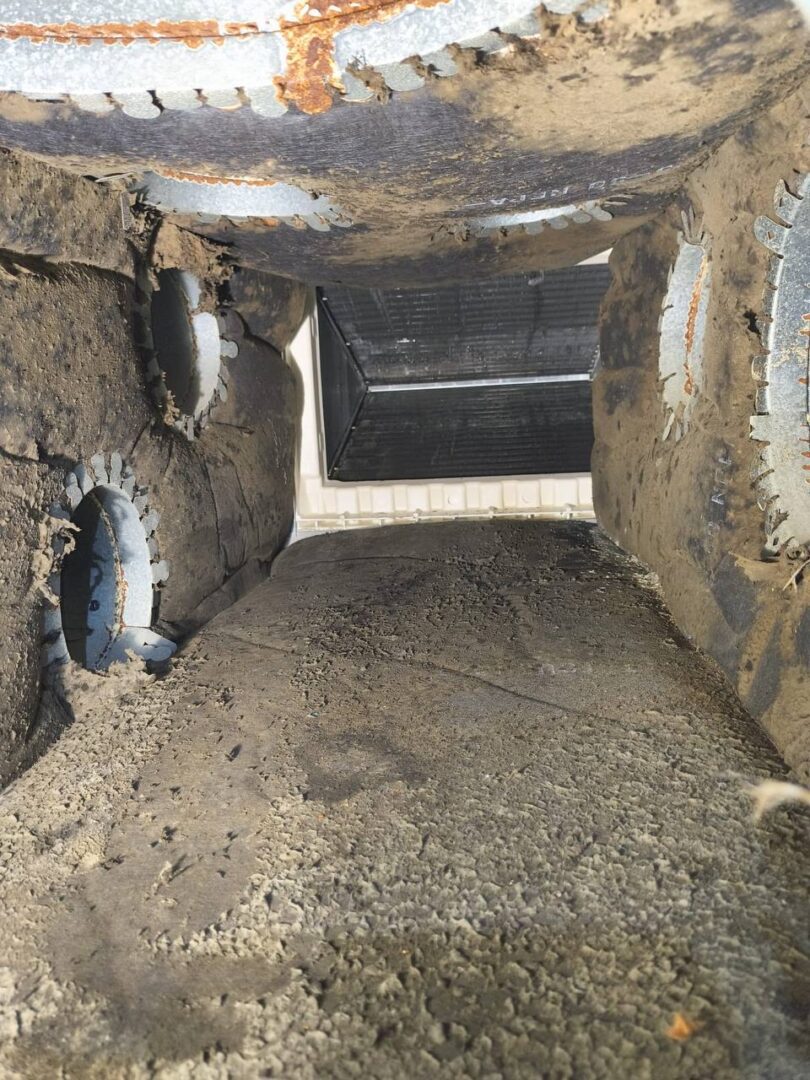
Deteriorating flex duct. Flex duct installed in the 1990s and early 2000s is reaching end-of-life in many homes. The liner material breaks down, releasing fine particles and creating irregular interior surfaces that trap debris. We’ve found flex duct sections in homes occupied by seniors that are partially collapsed, torn, or coated with breakdown products that generate particulate matter continuously.
Long-term mold accumulation. A Houston home with 20 years of humidity exposure and no professional duct cleaning has had extensive opportunity for mold establishment. We regularly find significant biological growth in these systems — growth that has been distributing spores into the senior’s living space for years.
Pest history. Older homes have had more time for rodent and insect intrusion. Evidence of past or present pest activity inside duct systems — nesting material, droppings, shed skins — is common in older Houston homes. These materials are potent allergens and in some cases pathogen vectors.
One memorable job in a Meyerland home was for a 78-year-old woman whose daughter had called us because her mother was experiencing worsening respiratory symptoms despite taking asthma medications she’d managed without for years. The home was 45 years old. The duct system had never been professionally cleaned. What we extracted from that system was striking — layered debris, significant flex duct deterioration, and biological growth in three sections. Her pulmonologist later noted improvement in her lung function measurements.
The Cardiovascular Connection
There is a reason air quality researchers focus so heavily on PM2.5 — particles smaller than 2.5 microns. These particles are small enough to cross the alveolar membrane directly into the bloodstream. Once in circulation, they trigger systemic inflammatory responses.
For a healthy 30-year-old, this inflammatory response is a transient inconvenience. For a 70-year-old with hypertension or atherosclerosis, it can be the difference between a stable day and a cardiovascular event.
Contaminated duct systems are continuous generators of PM2.5. Debris on duct walls — particularly from degrading flex duct liner and biological growth — sheds fine particles into the airstream every time the system runs. A senior living in a home with heavily contaminated ducts is receiving a continuous low-dose PM2.5 exposure that their cardiovascular system handles less well than younger individuals.
Respiratory Infections and Contaminated Ducts
Seniors have reduced immune response to respiratory pathogens. Infections that younger people clear in a few days can become pneumonia in older adults.
Contaminated duct systems don’t just distribute allergens — they can distribute biological material that increases pathogen exposure. Rodent-contaminated duct systems present a particular risk: rodent droppings can harbor hantavirus and other pathogens that, when dried and aerosolized by airflow, become inhalable. For a senior with reduced immune response, this is a serious risk.
Even beyond specific pathogens, the chronic immune activation caused by continuous allergen and irritant exposure — the low-grade inflammation from living in a contaminated air environment — reduces immune reserve. A senior whose immune system is perpetually managing airway inflammation has less capacity to respond to acute infectious threats.
What to Do in a Senior’s Home
The approach for a senior’s home prioritizes thoroughness and addresses any biological contamination found during the process:
Complete duct inspection and cleaning. [Residential duct cleaning](https://ahchooindoorair.com/residential-duct-cleaning) covering the full system — all supply and return ducts, register boots, air handler — removes the accumulated contamination reservoir. For a home with decades of accumulation, this is a significant intervention.
Mold remediation if needed. If active mold is found, [mold remediation](https://ahchooindoorair.com/mold-remediation) treats the growth properly rather than simply dislodging it. For seniors with respiratory vulnerability, ensuring mold is fully addressed — not just partially cleared — is important.
Duct integrity evaluation. Older homes often have duct sections that need repair or replacement. Leaks that pull in attic air bypass the filter and introduce unfiltered contaminants directly. Addressing these ensures the cleaned system doesn’t re-contaminate quickly.
Filter upgrade. MERV-13 filters for seniors’ homes help maintain lower particle loads going forward. Change every 30-60 days.
A Gift Worth Giving
Adult children managing aging parents’ homes often bring us in as part of a larger home care conversation. This is one of the most practical investments in a senior family member’s health — particularly in Houston, where the climate makes duct contamination faster and more severe than most places in the country.
The inspection is free. If the system warrants cleaning, the process takes one day and the benefit continues for years.
[Book your free inspection at crm.ahchooindoorair.com/book](https://crm.ahchooindoorair.com/book)
Frequently Asked Questions
Why are seniors more vulnerable to poor indoor air quality?
Aging lungs have reduced capacity and less efficient clearance mechanisms. Older adults also tend to spend more time indoors, often have cardiovascular conditions that are worsened by particulate exposure, and may take medications that impair immune response to respiratory pathogens. They also have a lifetime of accumulated lung exposure that reduces their reserve capacity.
What indoor air pollutants are most dangerous for seniors?
For seniors, the most dangerous indoor air pollutants are fine particulate matter (PM2.5), mold spores, and respiratory pathogens — all of which can exacerbate cardiovascular and respiratory conditions. In Houston, contaminated duct systems are a primary source of ongoing PM2.5 and mold spore exposure indoors.
How does duct cleaning benefit elderly residents?
Duct cleaning removes the accumulated reservoir of fine particles, mold spores, allergens, and debris that contaminated systems continuously distribute. For seniors, who often spend 20+ hours per day indoors, reducing the pollutant load in circulating air can meaningfully decrease respiratory and cardiovascular symptom burden.
How often should a senior’s home have duct cleaning?
For a senior living alone or with a caregiver, NADCA recommends professional duct cleaning every 3-5 years. However, Houston’s climate and the elevated health stakes for older adults make every 2-3 years a more appropriate interval — especially if respiratory or cardiovascular conditions are present.
Can poor indoor air quality cause cognitive symptoms in seniors?
Research suggests that chronic fine particulate exposure contributes to cognitive decline, and that VOC exposure impairs concentration and memory. For seniors already facing age-related cognitive changes, reducing indoor pollutant loads — including by cleaning duct systems that distribute these pollutants — supports clearer cognitive function.
Related Service Areas
- Why Allergies Get Worse Indoors in Houston
- Indoor Allergies in Houston — What You Can Do
- Asthma and Indoor Air Quality in Texas
- Baby Nursery Air Quality in Houston
Related AH-CHOO resources: Houston air duct cleaning; schedule a free inspection.