Kyle, Texas — the fastest-growing city in Hays County with a population of approximately 55,000 residents — sits along the I-35 corridor approximately 20 miles south of Austin at a unique geographic transition where the deep clay Blackland Prairie soils begin their shift toward the drier South Texas plains. This transitional geography, combined with explosive residential development and Kyle’s position along one of North America’s busiest freight corridors, creates indoor air quality (IAQ) challenges that are distinct from both Austin’s urban core and the Hill Country communities to the west.
Despite having a dedicated service page for Kyle air duct cleaning and related content such as the Kyle TX duct cleaning guide, Kyle has had no dedicated indoor air quality post until now. This guide fills that gap with a focused look at what makes Kyle TX indoor air quality unique and how NADCA-certified air duct cleaning addresses the specific contaminants found in homes across this rapidly growing Hays County community.
What Makes Kyle TX Indoor Air Quality Unique
Kyle’s IAQ challenges stem from five interconnected factors that differentiate this fast-growing I-35 corridor city from both the Austin urban core and other Hays County communities:
- I-35 diesel PM2.5 corridor. Kyle sits along the I-35 corridor — one of the most heavily trafficked freight routes in North America — and Kyle’s flatter, more open terrain compared to Austin’s hilly topography allows diesel PM2.5 to travel further into residential neighborhoods. I-35 carries approximately 150,000 vehicles per day through the Austin metro area, a significant percentage of which are diesel trucks. Kyle’s position south of Austin means it catches both local I-35 emissions and the cumulative corridor traffic from the Austin urban core. Most Kyle neighborhoods lie within 1-4 miles of the interstate, placing the entire city within the PM2.5 influence zone.
- Plum Creek watershed humidity. Unlike Buda’s Onion Creek hydrology, Kyle is centered on the Plum Creek watershed — a broad, slow-moving waterway that runs through the city’s most densely developed residential area, the Plum Creek master-planned community. The Plum Creek floodplain creates a sustained humidity microclimate that affects thousands of Kyle homes during warm months. The deep clay Blackland Prairie soils in this watershed retain moisture from creek overflow and rainfall, releasing it slowly through evaporation and maintaining elevated humidity levels even during dry periods.
- Construction dust from explosive residential growth. Kyle has experienced some of the fastest population growth in the United States — the city’s population has more than tripled since 2000, with master-planned communities including Plum Creek (thousands of homes), Waterleaf, Kyle Crossing, Clearwater, and Post Oak Estates under continuous development. This sustained construction generates PM10 coarse particulate dust from concrete, drywall, wood, and soil disturbance that blankets nearby properties and infiltrates HVAC systems.
- Limestone and clay soil dust. Kyle sits at the transition between the Blackland Prairie’s deep clay soils and the limestone-based soils that characterize the Texas Hill Country to the west. Homes in western Kyle areas experience fine alkaline limestone dust, while eastern neighborhoods contend with fine clay particulates. Both particle types accumulate in HVAC ductwork and recirculate through the home.
- Cedar pollen during winter juniper season. Kyle’s position south of Austin places it closer to abundant ashe juniper (mountain cedar) stands along the Blanco River corridor. During the winter cedar fever season (December through February), juniper pollen concentrations in Kyle can reach extreme levels, triggering allergic reactions in sensitized individuals and accumulating in HVAC systems as fine allergenic particulates.
I-35 Traffic Pollution and Your Kyle Home
The I-35 corridor presents Kyle’s most significant and persistent IAQ challenge. Unlike the Austin urban core where tree canopy and terrain variations provide some particulate filtration, Kyle’s relatively flat, open terrain allows diesel PM2.5 to disperse broadly across the city.
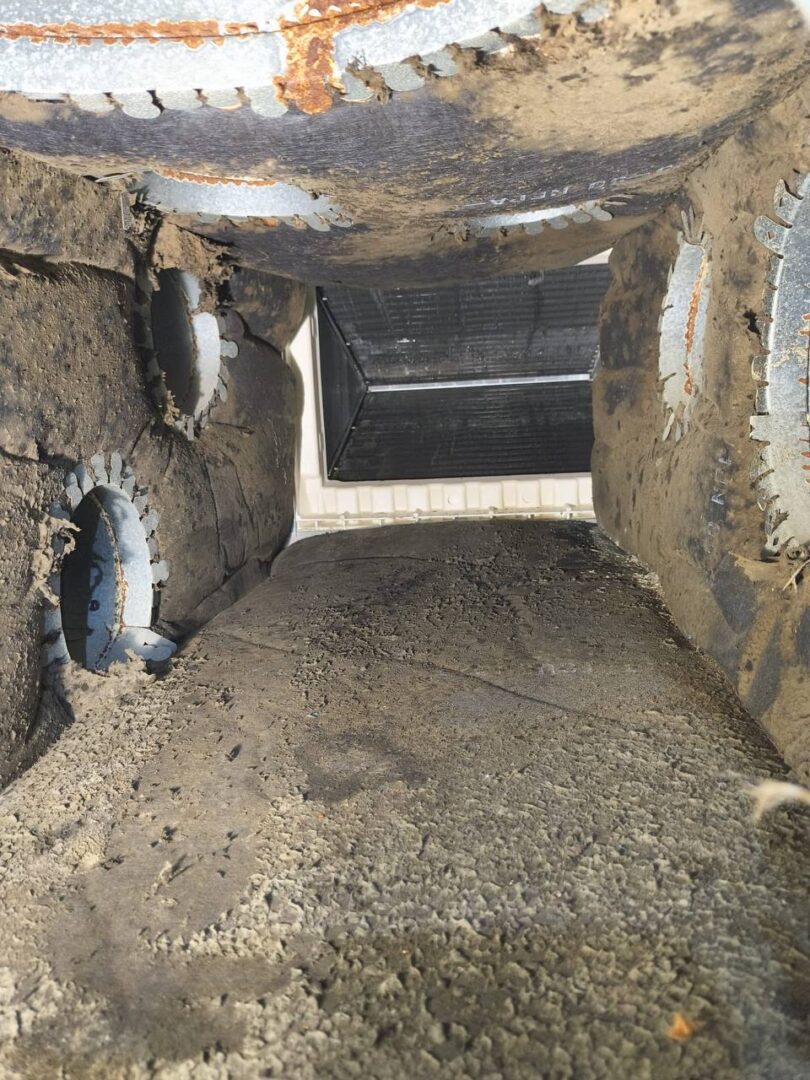
Diesel PM2.5 — fine particulates measuring 2.5 micrometers or smaller — is particularly problematic for HVAC systems. These particles bypass standard household filters, including many MERV 8-rated filters, and accumulate in ductwork, on evaporator coils, inside air handler compartments, and on blower wheels. Over time, diesel PM2.5 builds up as a dark, oily residue that:
- Reduces HVAC system efficiency by restricting airflow through ducts and across coils
- Creates a greasy surface that traps additional dust and particulates
- Can recirculate through the home each time the HVAC system operates
- Contributes to musty odors when combined with humidity
Kyle homes within 1-2 miles of I-35 — a category that includes most neighborhoods in the city’s western and central sections — experience the highest PM2.5 infiltration rates. However, because Kyle’s terrain lacks significant topographic barriers, homes as far as 3-4 miles east of I-35 still show elevated indoor PM2.5 levels compared to communities without interstate proximity.
Plum Creek Watershed Humidity and Mold Risks
The Plum Creek watershed — which runs through the heart of Kyle’s residential development, including the Plum Creek master-planned community and areas along Kyle Parkway — creates a distinct indoor air quality dynamic that differentiates Kyle from I-35 corridor communities located outside major creek floodplains.
The watershed’s broad floodplain, deep clay soils, and proximity to the creek’s surface water create a sustained humidity microclimate. During summer months — particularly May through September — indoor relative humidity in Kyle homes within the Plum Creek influence zone can exceed 60%, the threshold at which conditions become favorable for mold and mildew growth in HVAC systems.
Kyle homeowners in the Plum Creek area may notice:
- Musty odors when the HVAC system first runs after humid periods
- Visible mold growth on supply registers or in air handler compartments
- Increased allergy symptoms during humid months
- Condensation on ductwork in unconditioned attic spaces
Professional source-removal duct cleaning, combined with antimicrobial treatment when appropriate, addresses these humidity-driven IAQ concerns at their source by removing the accumulated microbial growth and the nutrient-loaded dust deposits that sustain it.
Construction Dust from Kyle’s Rapid Growth
Kyle’s explosive population growth — the city’s population has more than tripled since 2000, with no signs of slowing — means that construction dust is not a temporary inconvenience but a persistent IAQ challenge for many residents. Homes in developing neighborhoods like Waterleaf, Clearwater, and Kyle Crossing face active construction activity on adjacent lots for years after initial occupancy.
Unlike natural dust from soil and pollen, construction dust includes a complex mixture of particulates that differ by construction phase:
- Concrete and cement dust from foundation work — alkaline, abrasive, and hygroscopic
- Drywall joint compound dust — extremely fine calcium sulfate that remains airborne for extended periods
- Sawdust and engineered wood particulates from framing and finish carpentry
- Insulation fibers from fiberglass and blown-in cellulose products
- Soil and limestone excavation dust from site preparation and grading
These construction particulates enter homes through open windows during the building phase, through HVAC return air intakes located near construction activity, and through envelope penetration points. Once inside, they settle into ductwork where they create an abrasive, nutrient-rich substrate that can harbor microbial growth when combined with the Plum Creek watershed’s elevated humidity.
How NADCA-Certified Air Duct Cleaning Addresses Kyle’s IAQ Challenges
Kyle’s IAQ profile — heavy diesel PM2.5, sustained floodplain humidity, continuous construction dust, limestone particulates, and seasonal cedar pollen — requires a cleaning approach that removes accumulated contaminants from all HVAC system components rather than simply disturbing surface dust.
AH-CHOO’s NADCA-certified source-removal cleaning process — one crew, one home per day, 7+ hours of thorough work — addresses every IAQ contaminant Kyle homeowners face:
- Negative air agitation and HEPA vacuuming of the entire duct system to dislodge and capture diesel PM2.5 residue, construction dust, and pollen accumulations
- Compressed air tool cleaning of all supply registers, return air grilles, and duct branches
- Contact vacuuming of the air handler compartment, evaporator coil, blower wheel, and plenum — the areas where fine diesel particulates and clay dust accumulate most densely
- Antimicrobial treatment for homes with confirmed microbial growth from Plum Creek watershed humidity, using EPA-registered products applied to accessible duct surfaces
Source-removal cleaning is particularly important for Kyle’s combination of diesel PM2.5 and construction dust — a mixture that creates bonded residues on duct surfaces that cannot be removed by consumer-grade methods such as vacuuming registers or using duct cleaning aerosol products.
Frequently Asked Questions About Indoor Air Quality in Kyle TX
How does Kyle’s proximity to I-35 affect indoor air quality?
Kyle’s location along the I-35 corridor — one of North America’s busiest freight routes — means homes are exposed to elevated levels of diesel PM2.5 fine particulates. Kyle’s relatively flat, open terrain compared to Austin allows these particulates to travel further into residential neighborhoods. Homes within 1-4 miles of I-35 experience PM2.5 infiltration through door seals, window gaps, and HVAC return air intakes, with particulates accumulating in ductwork over time.
Does the Plum Creek watershed affect indoor humidity in Kyle?
Yes. The Plum Creek watershed runs through Kyle’s most densely developed residential areas, including the Plum Creek master-planned community. The creek’s broad floodplain, combined with deep clay Blackland Prairie soils that retain moisture, creates a sustained humidity microclimate. Indoor relative humidity in Plum Creek-zone homes can exceed 60% during summer months, creating conditions favorable to mold and mildew growth in HVAC ductwork and air handler compartments.
How does construction dust from Kyle’s rapid growth affect HVAC systems?
Kyle is one of the fastest-growing cities in Texas, with master-planned communities under continuous construction. Construction dust — including concrete, drywall, wood, and soil particulates — infiltrates HVAC systems through return air intakes and accumulates in ductwork. This construction debris creates an abrasive, nutrient-rich substrate that reduces airflow efficiency and can support microbial growth when combined with humidity.
Does AH-CHOO serve the Kyle TX area for air duct cleaning?
Yes. AH-CHOO provides NADCA-certified air duct cleaning, HVAC sanitation, and indoor air quality services throughout the Kyle TX area, including the Plum Creek master-planned community, Waterleaf, Kyle Crossing, Clearwater, Post Oak Estates, and all Hays County communities within our Austin service radius. Contact us to schedule a free in-home IAQ assessment.
How often should Kyle homeowners have air ducts cleaned?
For Kyle homes in the I-35 PM2.5 zone and Plum Creek humidity area, NADCA recommends air duct cleaning every 3-5 years. Homes in active construction zones, homes with occupants who have respiratory conditions, or homes that have experienced mold growth from humidity may benefit from more frequent cleaning. After major renovation or construction completion, a duct cleaning is recommended to remove post-construction debris from the HVAC system.
Disclaimer: This information is for educational purposes only. AH-CHOO’s air duct cleaning services are designed to improve HVAC system cleanliness and indoor air quality but do not prevent illness, cure allergies, or guarantee specific health outcomes. Individual results vary. Always consult a qualified healthcare provider for health concerns related to indoor air quality.
Related AH-CHOO resources: Austin air duct cleaning.