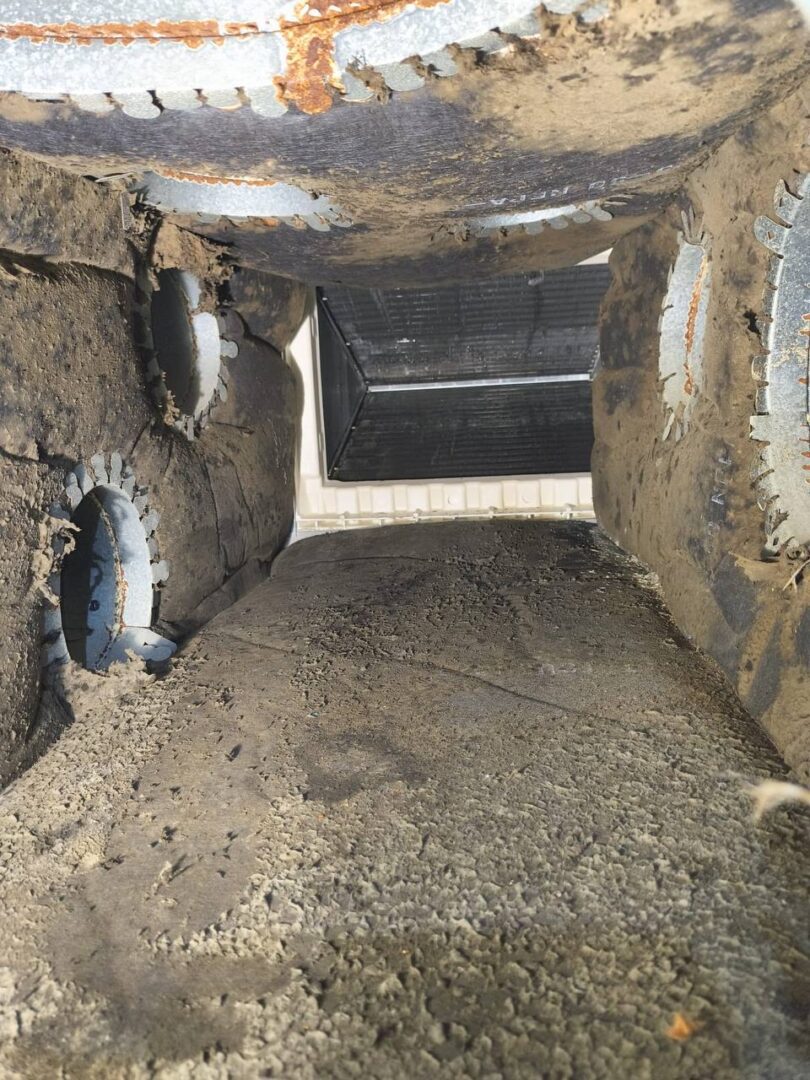
Mold inside your HVAC system is one of the most insidious indoor air quality problems because it operates out of sight. The ductwork, evaporator coil housing, and plenum box are enclosed behind access panels and finished surfaces, and by the time mold produces visible signs in your living spaces, it has typically been growing and distributing spores into your home for weeks or months.
Understanding the early warning signs that indicate mold may be growing inside your air ducts will help you identify the problem before it becomes a health hazard and a costly remediation project.
What to Watch For
**Musty or earthy odors when the HVAC system is running.** This is the single most common indicator of mold growth inside an HVAC system. Musty odors that appear when the A/C or heating system cycles on — and that dissipate when the system is off — point directly to biological growth inside the ductwork, plenum box, or on the evaporator coil. These odors are caused by microbial volatile organic compounds (MVOCs) that mold releases as it metabolizes organic material on interior duct surfaces.
**Visible mold growth on or around vent registers.** If you see dark spots, streaks, or any fuzzy growth on the interior surfaces of your supply or return vent covers, it means mold has established at the termination points of your duct system. The presence of visible mold on register covers strongly suggests that mold colonization has spread further inside the ductwork and is being distributed throughout the system.
**Visible mold inside the evaporator coil housing or plenum box.** If you can access these components through their inspection panels and see mold growth on the coil fins, the interior surfaces of the plenum box, or on adjacent ductwork, active mold colonization has already established inside your HVAC system.
**Increased allergy symptoms or respiratory irritation that improves when you leave home.** Mold spores distributed through ductwork are circulated throughout every room when the system operates. If household members experience congestion, coughing, wheezing, itchy eyes, or skin irritation that is noticeably worse inside the home and improves when family members are away, mold contamination in the HVAC system is a likely contributor.
**Excessive dust or debris on surfaces shortly after filter changes.** If you replace your air filter on schedule and notice that dust accumulates on furniture and countertops far more rapidly than expected, it may indicate that the debris source is inside the duct system itself and is being continuously redistributed by the HVAC system.
**History of water intrusion or flooding.** If your home has experienced any water intrusion event that may have contacted your HVAC system — roof leaks, plumbing failures, flooding, or even significant condensate drain overflow — mold growth inside the system should be assumed until a professional inspection confirms otherwise.
What You Should Do When You Notice Signs of Mold
**Do not turn on the HVAC system.** If you suspect active mold growth inside your system based on the signs described above, the safest action is to keep the system turned off until it has been professionally assessed. Operating a mold-contaminated system distributes spores into every room your system serves.
**Schedule a professional inspection immediately.** A NADCA-certified technician will examine all 8 HVAC components — return ducts, evaporator coils, blower fan, heating chamber, plenum box, supply ducts, register boxes, and grills — and determine whether standard duct cleaning or professional mold remediation is required.
**Do not attempt to clean the system yourself.** DIY mold removal products and household cleaners are not effective for treating mold growth inside the confined spaces of ductwork and HVAC components. Professional source removal cleaning and anti-microbial treatment are required to eliminate active mold colonies.
What Professional Assessment and Remediation Involves
Our NADCA-certified mold assessment begins with a comprehensive inspection of all 8 HVAC components. We document the extent of mold colonization with photographs and written assessment, and we determine whether standard cleaning is sufficient or whether professional mold remediation with containment and anti-microbial treatment is required.
The average remediation service takes approximately 7 hours because the process requires careful, methodical treatment of every contaminated surface. We include a free pre-remediation inspection so you can see the extent of the contamination before making any commitment.
Book Your Free Mold Inspection
If you have noticed any of the signs described above and want a thorough, no-pressure evaluation of your HVAC system’s condition schedule a free inspection today. Our NADCA-certified technicians will document the condition of all 8 components and provide an honest recommendation.
[Book a Free Inspection](https://crm.ahchooindoorair.com/book)
AH-CHOO! Indoor Air Quality serves Houston, Austin, San Antonio, and South Louisiana. NADCA certified. Average job time: 7 hours. 8 components cleaned every service. 38 years of experience.
Related AH-CHOO resources: Houston air duct cleaning; schedule a free inspection.